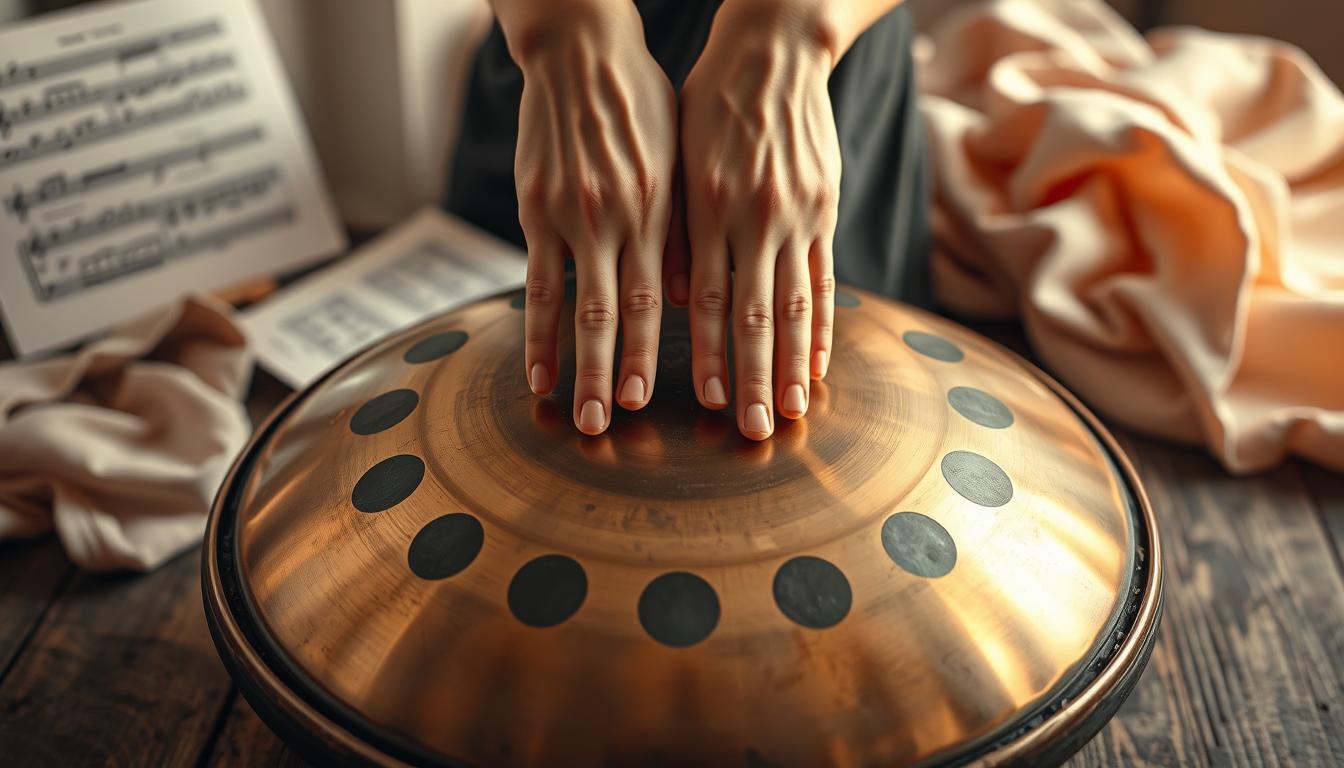
What this guide offers: it helps you read 9-note handpan sheet music and turn what you read into practical movements.
Who is it for? Motivated beginners and curious musicians will find clear ways to improve their accuracy, rhythm and coordination.
We will briefly compare sheet music and tablature: sheet music shows rhythm, note lengths and dynamics; tablature helps you identify where to strike. The two approaches work well together and are accessible without extensive knowledge of music theory.
Key idea: nine sounds provide an ideal starting point. Few notes can still offer plenty of musical expression, making it easier to learn memorable patterns.
The method: understand the instrument, choose sheet music or tablature, read the bars and tempo, practise progressively harder exercises, then create variations and develop expression.
Suggested tools: a metronome, a pencil for annotations and a device for recording audio or video. For practical resources, see useful apps and reference sheets.
Understanding a 9-note handpan and how its music is written
The instrument’s circular layout gives you a visual and tactile reference for every pattern. The centre, called the Ding, acts as an anchor, while the surrounding tone fields form a map for melodies.
Practical playing landmarks:
- Use the Ding as a fixed point and follow the curve of the surrounding tone fields.
- Feel the distances between them: let the instrument’s shape guide your hands and avoid tension.
- Move along circular paths to keep your movements fluid.
Simple numbering and memorisation
Adopt a simple code: D for the Ding, followed by numbers for the other positions. This system replaces complex note names.
Method: associate each number with a position and a timbre, then check each note by ear. Repeating this process strengthens your mental map and speeds up learning.
Why nine sounds make learning easier
With a limited number of notes, the range of sounds remains manageable. Repeated patterns become familiar quickly.
A coherent scale, such as D Kurd if that matches your instrument’s tuning, is enough to play complete musical phrases without extensive knowledge of music theory.
In short: knowing the instrument’s shape and playing areas makes written symbols easier to understand. The next sections show how to turn those landmarks into precise movements.
Choosing between handpan sheet music and visual tablature for your level
The way music is presented changes how you work on rhythm and spatial memory. Your choice will shape your first weeks of practice and help clarify your priorities.
What sheet music provides: rhythm, rests and dynamics
Sheet music describes the pitch and length of notes, as well as rests. It teaches you to time each strike precisely.
Working from sheet music helps you maintain a steady tempo and refine your dynamics. It is the tool for reproducing a piece faithfully.
What tablature provides: striking areas at a glance
Tablature provides a view from above. It shows where to strike without requiring advanced music-reading skills.
For beginners, this spatial guide speeds up memorisation and helps them play patterns quickly.
An effective approach: combine tablature and sheet music
Start by learning a pattern from tablature. Then use simplified sheet music and a metronome to bring that pattern into time.
If your coordination stops improving, a focused lesson can help you overcome difficulties and learn how to position your hands.
| Format | Immediate benefit | Ideal level | Recommended use |
|---|---|---|---|
| Sheet music | Rhythmic accuracy and dynamics | Intermediate to advanced | Structure and reproduce pieces |
| Tablature | Quick spatial reference | Beginner | Memorise patterns and start playing quickly |
| Both combined | Benefits of both formats | Intermediate | Learn a pattern, then practise it with a metronome |
Reading 9-note handpan sheet music: bars, beats, tempo and hand placement
Reading a score takes a methodical approach. Start by identifying the rhythmic and visual structure of each bar. Read from left to right: find the bars, then count the beats and subdivisions to know when to strike.
A practical way to decode it:
- Mark the beats and eighth notes in pencil to see how the rhythm unfolds.
- Use 60 BPM as a starting point, roughly one beat per second, then increase the tempo in stages once your playing is accurate.
- Count quietly at first to steady your rhythm, hands and breathing.
Two-line layout
A centre divider separates the lines: the upper line represents the right hand and the lower line the left. This division makes coordination easier to read and helps prevent your hands from colliding.
Matching positions and playing notes together
Numbers correspond to positions on your instrument, depending on its tuning. Two numbers on the same subdivision indicate coordinated strikes: play them together and listen to the resulting resonance.
| Step | Action | Expected result |
|---|---|---|
| Identify the structure | Find the bars, beats and subdivisions | Precise timing for each strike |
| Annotate | Mark eighth notes, sixteenth notes and rests | Visual cues that prevent timing errors |
| Set the tempo | Start at 60 BPM and increase it in stages | Accuracy before speed |
Reading handpan tablature: diagrams, colour codes and how to address its limits
Think of tablature as a series of snapshots: each diagram captures one musical moment. The view from above shows where to strike the instrument at a particular time.
Tablature is a sequence of diagrams. Each diagram associates a playing area with a symbol or colour. Check the key before playing.
Some tablatures use two lines to distinguish the hands. This reduces confusion and clarifies what each hand should do.
Be aware that these diagrams rarely show the tempo, exact note lengths or dynamics. Following the diagrams alone may produce an approximate performance.
To fill those gaps, practise with a metronome, listen carefully and repeat patterns in slow loops. Sing or count the beat as you follow the diagrams.
| Element | What the tablature shows | How to fill the gap |
|---|---|---|
| Diagram or snapshot | Position and order | Use a metronome and slow loops |
| Colour codes | Playing areas and accents | Check the key and listen |
| Two lines | Which hand plays what | Practise each hand separately, then combine them |
9-note handpan sheet music: exercise ideas for the right and left hands
Short routine, clear goal: begin with two minutes for each hand separately, then bring them together. Practise slowly and increase the tempo in stages only while your movements remain accurate.
Right-hand exercises: accuracy and rebound
Goal: a clean strike followed by an immediate release.
- Repeat two or three nearby notes in time with a metronome.
- Accent the first strike and let your hand rebound.
- Vary the speed and intensity for one minute.
Left-hand exercises: consistency and grounding
Play steady strikes, as though your hand were an internal metronome.
- Strike a low note every four beats.
- Add accents and releases without changing the tempo.
Alternation and independence
Go up and down the scale using a fixed pattern, such as Ding, 1, 2, 3 and back, until the movements become automatic.
Ostinato and melody
Keep a simple ostinato going on the Ding and a low note while playing a short phrase with the other hand. This builds independence.
Focused transitions
Practise moving back and forth between the Ding and the outer tone fields, looking for the most relaxed path.
Quick routine: two minutes with your hands separately, two minutes together, two minutes on accents, then two minutes at five BPM faster if your playing remains accurate. For more ready-to-use scores, see our selection.
Useful symbols and striking techniques to enrich your scores
Understanding the markings on the page helps you play with musical intent. Symbols indicate the attack, duration and sound quality to aim for on this instrument.
Common symbols:
- Ding: the centre, producing a full, resonant sound.
- Shoulder: an edge or shoulder strike, producing a drier sound suited to rhythm.
- Slap: a percussive strike for rhythmic effect.
- Tak: a sharp edge strike, useful in an ostinato.
- Ghost note: a light, almost silent strike.
- Mute or palm mute: an immediate dampening of the resonance.
These symbols describe more than a note. They express an intention: play a dry sound to support the rhythm or let a note ring to open up a phrase.
Movement guidance: strike at a controlled angle, using a fingertip or knuckle as appropriate for the area, then release immediately to preserve the tone. Avoid abrupt movements on areas that are not intended to be struck.
Mini exercise: play the same pattern twice, first letting the notes ring and then muting them. Compare the results and mark on your scores where you want each articulation.
Volume and care: increase volume through precise movement without striking forcefully. A controlled movement protects the instrument and preserves its sound quality.
A daily practice method for turning reading into fluid playing
A clear routine helps turn reading into automatic movement. Here is a simple, effective method to practise each day.
A typical 15- to 30-minute routine
Warm-up: spend two to three minutes playing slow strikes to warm up your fingers.
Slow reading: follow the score at a slow tempo for five minutes.
Hands separately: spend five minutes on each line, then five minutes with both hands together.
Focused repetitions: finish with five to ten minutes on one small goal, such as two bars, a pattern or a transition.
Count and annotate
Count the beats and subdivisions quietly to time your strikes. Mark difficult passages in pencil. Circle transitions and note which hand plays each line.
Metronome and recording
Start very slowly with a metronome, then increase the tempo in five-BPM steps when your playing is accurate.
Record audio or video of yourself to identify timing slips, dynamics that sound too uniform and tense transitions. If your coordination stops improving despite practice, a focused online lesson may help.
Rhythm and musicality: let your 9-note melodies breathe
Rhythmic breathing turns a simple sequence into a living phrase. With a limited number of notes, musical character comes much more from rhythm than harmonic complexity.
Rests, sustained notes and timing: let a note ring when it serves as an anchor. Cut another short to create a breath. These choices make the phrase clear and expressive.
For example, move a strike to an offbeat, extend a note by a quarter note or shift the accent without changing the pitch. The feel of the piece changes immediately.
Build variations from a foundation pattern
A simple method: keep a two-bar pattern as your reference. Then create three variations by changing just one element at a time:
- Rhythm: change the subdivisions.
- Intensity: play softly or loudly.
- Articulation: play legato, mute the notes or play staccato.
To check your work, record all three versions at the same tempo. Compare their steadiness, musicality and beat placement. Mark rests and dynamics on your score so you can repeat the same intention.
| Element | Action | Effect |
|---|---|---|
| Rest | Omit a planned strike | Creates space and contrast |
| Sustained note | Let a key note ring | Provides an anchor |
| Timing | Move a strike to an offbeat | Changes the piece’s rhythm |
For more guidance on putting this into practice and finding useful reference sheets, see this resource.
Find, print and create your handpan scores as PDFs
Find and organise your scores as PDFs so they are useful in daily practice.
Where to download them: favour sites that specify the tuning, scale and number of tone fields. Look for PDF collections that say whether the files contain tablature or full scores.
Compatibility checklist
- Check the scale, such as D Kurd if your instrument is tuned that way.
- Confirm that the layout has nine tone fields or check the stated number of notes.
- Look for hand assignments and rhythmic markings on the sheet.
Print, laminate and annotate
Print on A4 paper, laminate the sheets and use an erasable marker. Note your target tempo, symbols and areas to practise.
Compose with Notepan
Start with a simple pattern, test it with a metronome and write down its structure. In Notepan, choose the scale and number of tone fields, listen to the result as you work, and adjust the tempo, duration and intensity before exporting a PDF.
When to take a lesson
An online lesson can help if you want to improve your coordination and rhythm quickly. Personalised feedback speeds up learning and helps prevent bad habits. Note: the SELA Melody D Kurd SE220 is often mentioned as a reference instrument for beginners.
Conclusion
In summary, effective practice combines spatial landmarks with slow rhythmic work.
The guide’s approach: understand the handpan, choose a suitable format, read the rhythm and organise your hands, then practise focused exercises in short loops.
Progress in stages: play slowly and with control, repeat brief passages and raise the tempo gradually. A metronome, attentive listening and recording help steady your playing and develop musicality.
Create your own patterns, write them on a score or diagram and keep developing them. For ready-to-use sheets, see handpan sheet music.
Seven days of guided practice: one exercise for the right hand, one for the left, then an ostinato accompanied by a melody. The final goal is fluid, expressive playing that remains comfortable and treats the instrument with care.