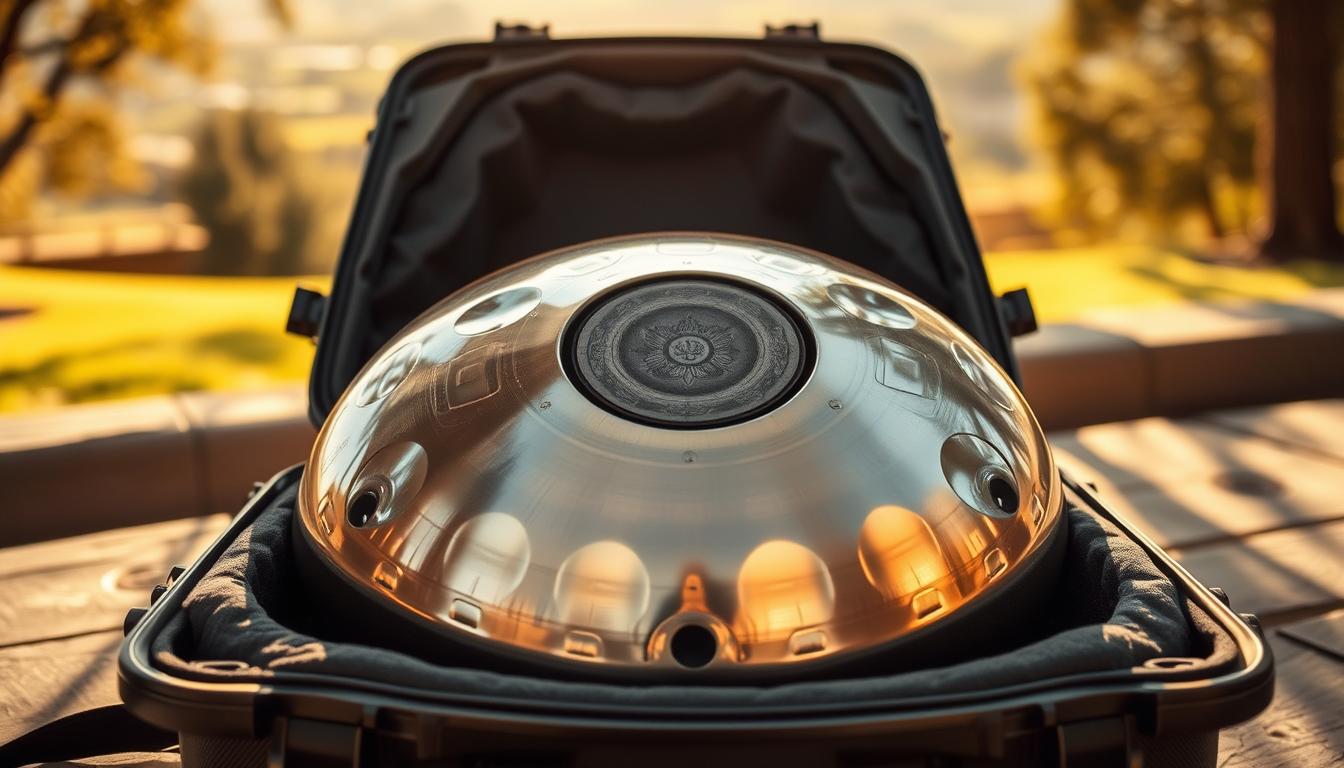
Traveling with a handpan can quickly become stressful. Airports, security checks and crowds increase the risks for this rare, delicate and expensive instrument. Drawing on ten years of experience on the road, this guide offers practical ways to reduce those risks.
This practical guide explains why good protection matters. It covers the two main options: a padded bag and a hard case, and how each protects against impacts, pressure, moisture and loss of tuning.
It is intended for traveling musicians, students, touring professionals and first-time handpan owners. You will find the key factors to consider: type of journey, level of risk, acceptable weight, budget, insurance and documentation.
At the end of the page, checklists and practical tips will help you label and pad your case and decide between cabin and checked baggage. To explore specific options and tested models, see this practical resource.
Understanding the risks of traveling with a handpan
On the road, every jolt and temperature change can threaten your instrument’s tuning.
Impacts, small knocks and vibrations quickly add up: suitcase wheels, conveyor belts and uneven roads all take their toll. These forces create tiny deformations that affect tuning. Marks and dents may appear, but the real problem is often invisible.
Pressure also plays a crucial role. Stacked luggage, compression in a compartment or a poorly secured instrument in a car trunk can create mechanical stress. This changes the tension in the metal and can cause lasting tuning problems.
Moisture and temperature changes
Moisture can come from sweat, sea air, rain or condensation caused by air conditioning. It encourages corrosion and damages protective coatings. Desiccant packets inside the case reduce this risk.
Temperature changes cause metal to expand and contract. Moving from outdoor cold into a heated room can put stress on the notes. Let the instrument acclimate before playing.
| Risk | Cause | Effect | Precaution |
|---|---|---|---|
| Repeated impacts | Suitcases, conveyor belts, roads | Loss of tuning, dents | Hard case or suitable padding |
| Compression | Stacked luggage, tight compartments | Structural deformation | Internal padding and a fragile-item label |
| Climate | Moisture, temperature changes | Corrosion, changes in sound | Desiccant packets and acclimation |
To discover tested padded bags, browse this selection. If a crack appears along a metal edge, a method similar to instrument repair work may help you repair a crack.
Conclusion: the best protection combines impact resistance with control over environmental conditions. Whether you choose a soft bag or a hard case depends on the risks of the journey.
Choosing the right protection: padded bag or hard case
Your choice depends on the journey and how much handling the instrument will undergo. For a short journey that you control, a padded bag offers comfort and mobility. It protects against minor knocks and makes travel by car or train easier.
Limitations: a soft bag offers little resistance to compression, serious falls or airport baggage handling. If the instrument may be placed under other luggage, checked into the hold or taken through several connections, a hard case becomes essential.
Purpose-built models such as the Evatek or Polycase from Hardcase Technologies provide greater protection. Adding a Fly Kit stiffens the base and may keep the total weight manageable, for example, at 8 kg or less for an average setup.
| Situation | Recommended option | Why |
|---|---|---|
| Short or controlled journey | Padded bag | Mobility, comfort and protection against minor knocks |
| Tours, checked baggage or connections | Hard case with Fly Kit | Resistance to crushing and airport baggage handling |
| Budget airline flight | Hard case, after checking its weight | Compliance with baggage limits and better protection |
Features that make a difference: sturdy closures, reinforced seams, water resistance, padded shoulder straps and a rigid base.
Quick checklist before buying: test how securely your instrument fits, check the rigidity of the base, the quality of the straps and how easily the case opens. Make sure its size and weight meet your baggage requirements.
Handpan bags and hard cases: how to protect your instrument when traveling
Preparing the case before every trip greatly reduces the risk of damage. Proper padding stops the instrument from moving and cushions impacts. A few simple steps can improve safety and preserve sound quality.
Preparing the inside: padding, fabrics and scratch protection
Work in stages: first place a soft cloth beneath the shell. Then add layers of clothing to prevent any movement.
Protect sensitive areas with a microfiber cloth. Avoid direct contact with hard objects or metal zippers.
For long journeys, add bubble wrap or foam inserts at likely impact points. If staff will handle the bag, remember to place an instruction sheet inside.
Labels and traceability
Attach a legible exterior label with your name, phone number and email address. Add Musical Instrument – Fragile without overcrowding the label.
Put a label inside as well, and take a photo of the closed case. These precautions make it easier to trace the instrument if it is lost or stolen.
Insurance: key checks before departure
Before boarding, make sure your policy covers damage, loss and theft abroad. Check the insured value, deductible and claims procedure.
Ask the carrier about check-in rules and raise any questions at the counter if needed. Good preparation improves your chances of keeping the instrument in the cabin or recovering it undamaged after a trip in the hold.
Flying with a handpan: cabin, hold and effective strategies
You have two practical options when flying: keep the instrument in the cabin as carry-on baggage or check it into the hold. Each requires different preparation and precautions.
Cabin: according to one account, airlines accept the instrument as carry-on baggage about 99% of the time, although occasional refusals occur. To improve your chances, arrive at least two hours before departure, explain the situation calmly at the counter and show photos demonstrating that the case fits in an overhead bin.
A tip for overhead bins
Keep the photos handy. They can reassure staff and speed up check-in. Try to board early, or ask to use a closet near first class if the aircraft is small.
Budget airlines and checked baggage
Budget airlines often limit carry-on baggage to 8 kg and one piece. If the instrument is refused in the cabin, use a very rigid case and hand it over at the oversized-baggage counter for transport in the hold.
| Option | Advantage | Risk |
|---|---|---|
| Cabin, as carry-on baggage | Access to the instrument, oversight and no heavy baggage handling | Uncertain space, possible refusal |
| Hold, as checked baggage | Hands free, no need to board early | Impacts and pressure: a hard case is necessary |
| Budget airline flight | Attractive fare | Weight and size restrictions, often 8 kg |
On arrival, inspect the case, take photos immediately if you find damage and file a report. For more advice on traveling with a handpan, read this resource before your next flight.
Traveling with several handpans: improving safety and managing costs
Transporting several instruments on tour calls for planning and a systematic approach.
Several instruments in the cabin: sometimes possible
In some cases, major airlines allow two pieces of carry-on baggage if the aircraft is not full.
Explain the situation calmly at the counter. Show photos and ask to board early.
Checked baggage and extra charges
If an instrument must travel in the hold, budget for the cost. Typical figures reported are around €50–80 for a second bag and €150–250 for a third, depending on the airline.
Budget tip: buy baggage options in advance and allow extra for accessories.
Packing two handpans together: wrapping and padding
To reduce risks and bulk, wrap both instruments together or use a large reinforced military-style bag.
- Place soft separators between the shells.
- Use thick fabrics to absorb impacts.
- Secure everything firmly, then shake it gently to check that nothing moves.
“Fewer bags mean fewer risks, but protection and padding are still essential.”
Traveling by land: car, train and public transport
Whether you travel by car or train, a few rules can help keep your instrument safe.
By car: stable placement, cushioning and mistakes to avoid
First, place the instrument on a stable surface. The floor behind the front seats is ideal: the case cannot roll and is less likely to tip over.
Cushion impacts with thick blankets or pillows. Lightly securing the case with straps or a net prevents it from sliding during sudden braking.
- Common mistakes: leaving the case unsecured on a seat, putting it in the trunk without padding it or stacking luggage on top.
- Do not leave the instrument in the sun inside a closed car or expose it to prolonged cold. These temperature changes affect the metal and its tuning.
Train, bus and subway: keep the instrument close
Travel at quieter times when possible, and keep the bag beside you and in sight.
Avoid overhead racks, where other bags could crush it. In a crowded vehicle, politely ask for help keeping the instrument secure.
A well-chosen case reduces the stress of making connections. In short, fewer impacts, fewer temperature changes and constant supervision remain the best rules for traveling with peace of mind.
Conclusion
In summary: follow a simple process for a less stressful journey. Understand the risks, choose suitable protection, prepare the padding and adapt your plan to the trip.
Priorities: a hard case and good padding against impacts, control of moisture and temperature changes, and constant attention to your baggage.
Three habits for flying: check the airline’s rules, arrive early to explain the situation at the counter and ask to board early to improve your chances of keeping the instrument in the cabin.
Backup plan: if the instrument must go in the hold, use a genuinely rigid, well-padded case. More practical information.
Before and after the journey: prepare labels and documents, and arrange suitable insurance. On arrival, inspect and photograph the instrument, then check its tuning immediately. A short checklist is better than an expensive repair.