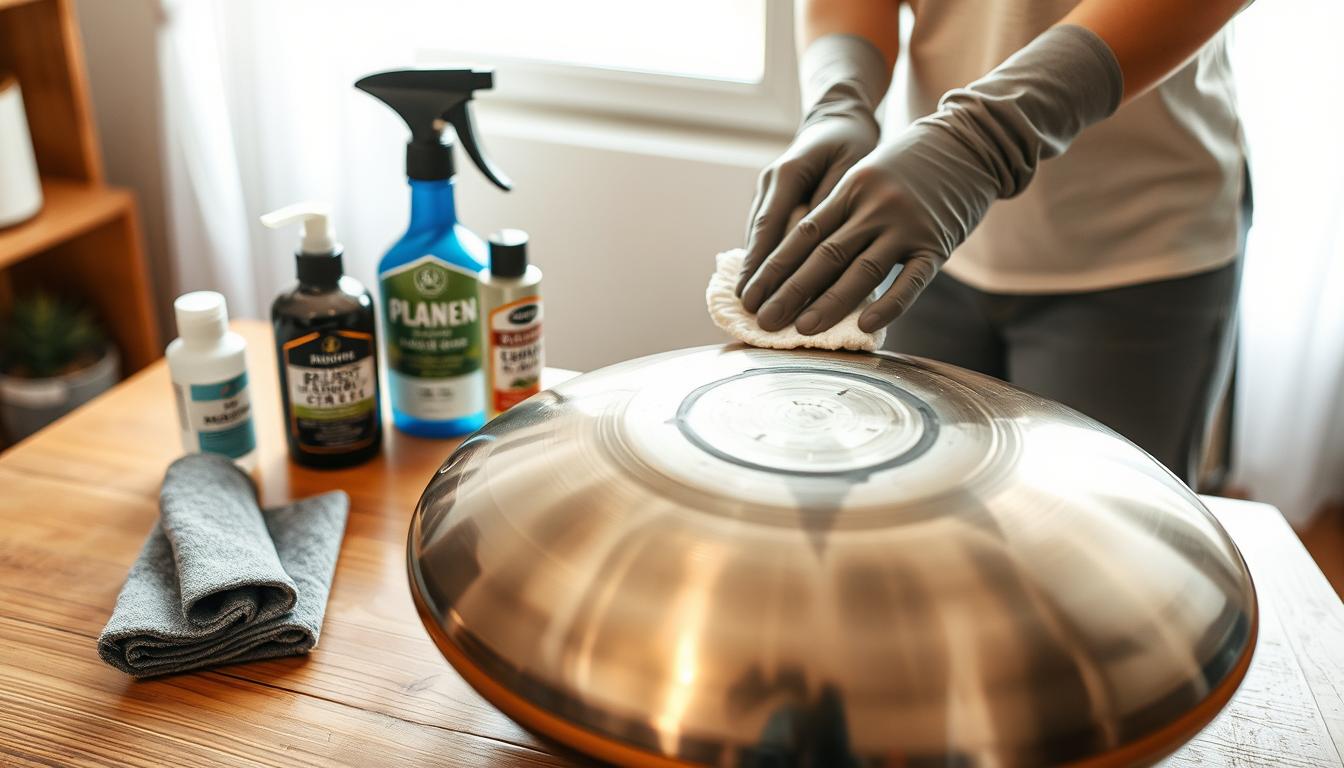
Goal: establish a simple routine to keep your instrument clean, stable and long lasting without damaging its finish.
Why act before a problem appears? Treated steel remains sensitive to moisture, salt and dust. Regular preventive care often avoids lengthy repairs.
This guide covers daily cleaning, the steps needed for a deep clean, applying a suitable oil and a gradual approach to treating corrosion. Every instrument reacts differently depending on its steel, finish and environment; always check the maker’s recommendations.
The principle is simple: clean + dry + properly stored. This combination remains the best defence against wear and rust.
For practical advice and a detailed method, see this complete care and protection guide.
Understand what damages a handpan during everyday use
To protect an instrument, first understand what wears down its surface over time. This simple assessment helps you adapt your routine to the climate and the player.
Sweat, salt and moisture: sweat contains mostly water and some salt. These traces form a film that speeds up oxidation in humid or coastal air.
Some people produce more corrosive sweat. Care should therefore take the player into account, not just the instrument.
Invisible threats: dust settles in recesses. Fine dirt holds moisture. Light rain or sea spray encourages spots to appear on the finish.
Nitrided steel and stainless steel
| Characteristic | Nitrided steel | Stainless steel |
|---|---|---|
| Corrosion resistance | Good, but limited | Very high, but not absolute |
| Care frequency | Higher under demanding conditions | Less frequent, depending on the climate |
| Effect on the patina | Treatment may change its appearance | Fewer visible changes, but care is still needed |
Understanding where spots come from helps you choose the right steps and avoid harsh products that damage the patina.
Good habits after every use
A few seconds are enough. Always wipe the surface after playing to reduce marks. This simple step protects the sound and the finish.
Wipe both sides with a soft microfibre cloth
Use a soft, clean, dry cloth every time you put the instrument away. Wipe the top, then the underside, and finish with the rim.
Wash and dry your hands to reduce salt deposits
Wash your hands before playing and dry them completely. This reduces salt and oil deposits that speed up deterioration.
Never put a damp instrument in its case
Golden rule: if the instrument is damp, do not close it inside its case. Trapped moisture causes spots and encourages corrosion.
- A 30-second routine: top → underside → rim, paying particular attention to contact areas.
- Microfibre picks up residue more effectively and reduces fine scratches compared with a rough fabric.
- If you play outdoors, wipe the instrument more often during the session, especially around sea spray or dust.
| Quick action | Why | Frequency |
|---|---|---|
| Wipe with a cloth | Removes sweat and dust | After every use |
| Wash your hands | Reduces salt deposits | Before playing |
| Do not close the case if the instrument is damp | Prevents moisture from becoming trapped | Always |
If a cloth is no longer enough, a deeper clean is needed. For the full method, see the care and protection guide.
A quick reminder: regular care and a little attention extend the life of this instrument and preserve its tone.
Deep-clean a handpan without damaging it
More thorough care is needed when the surface feels sticky or deposits remain in its recesses.
Warning signs: a greasy film, persistent marks, salt deposits, ingrained dust or a sticky feel. These signs indicate that it is time for a deep clean.
Using alcohol properly
Choose rubbing alcohol based on isopropyl alcohol or ethanol, at a concentration of 50 to 75%. Apply it to a soft cloth, never directly to the metal.
Wipe evenly using light pressure. Change the cloth as soon as it gets dirty. Keep contact time short to preserve the finish.
Full cleaning and stubborn spots
Work in this order: top → underside → rim. Finish with the inside, reaching through the Gu opening to remove moisture and residue.
For a stubborn spot, make several passes instead of rubbing hard. This protects the patina and the tuning.
Products to avoid and what to do after cleaning
Avoid acetone and harsh solvents: they dull the finish and may weaken the adhesive joining the shells.
Note: alcohol removes most of the oil layer. After cleaning, apply suitable protection.
| Problem | Action | Why |
|---|---|---|
| Greasy or sticky film | Alcohol on a cloth | Removes oil and salt |
| Deposits in recesses | Repeated passes; reach inside through the Gu opening | Cleans without hard rubbing |
| Spot caused by a chemical | Avoid acetone | Protects the finish |
Handpan maintenance: everyday cleaning, rust prevention and protection
Cleanliness and dryness are essential. Wipe the surface after every session and keep the case clean. If possible, take the instrument out of its case to let air circulate.
Oil it or ask the maker for advice
Oiling is not always necessary. Some makers recommend a light coat; others advise against adding anything. Always check the maker’s recommendations before applying a product.
Gas nitriding: useful, but limited
Nitriding increases corrosion resistance. However, it does not provide complete protection. Do not let it give you a false sense of security: inspect the surface regularly.
Watch for porosity: a small amount may be enough
A porous surface can absorb too much oil. Excess oil makes the shell greasy and may affect sound quality.
“A thin coat, thoroughly wiped down, is better than an uncontrolled buildup.”
| Approach | Benefit | Limitation |
|---|---|---|
| Cleaning and drying routine | Simple and effective | Requires frequent care |
| Light oiling | Protects against salt | Compatibility varies |
| Nitriding | Greater resistance | Does not fully prevent rust |
Practical rule: add a few drops, spread them into a thin coat and wipe away the excess. Next, let’s look at how to choose and apply the oil.
Choose and apply a suitable protective oil
A well-chosen protective oil creates a thin film that limits oxidation without making the surface slippery.
Simple options: choose a light, skin-safe oil. Organic grapeseed oil and coconut oil are suitable for occasional use.
Specialist oils
For targeted care, consider familiar products: Phoenix Oil, Metal Sounds Oils and Isthmus Oil. These products are formulated for metal and leave a very thin film.
Application steps
- Put a few drops on a soft cloth reserved for this purpose.
- Spread the oil evenly over the entire surface using circular movements.
- Leave it for a few minutes, then wipe away the excess until the surface feels dry to the touch.
Before applying more oil: if the existing coat is uneven or contains residue, remove it with a little alcohol on a soft cloth, then oil the instrument again.
| Step | Action | Suggested frequency |
|---|---|---|
| Light application | A few drops, followed by wiping away the excess | Several times a month, depending on climate and use |
| Remove the old film | Isopropyl alcohol on a cloth | As needed, before applying a new coat |
| Choose a product | A light oil or specialist formula | Maintain a consistent routine |
For the full method and practical advice, see the care guide.
Remove rust from a handpan step by step
Do not panic: an early brownish spot is often only cosmetic. The sound remains intact as long as corrosion has not perforated the shell.
Step 1 — Initial cleaning: dampen a soft cloth with alcohol and wipe the surface, rim, underside and inside through the Gu opening. Work on small areas at a time.
Step 2 — Very gentle rubbing, optional: if the spot remains, use a slightly dampened abrasive sponge. Rub in circles with very little pressure. Stop if the finish starts to show marks.
Step 3 — Targeted polishing, optional: a “Miracle Cloth” type polishing cloth, used in circular movements, removes stubborn marks. Polishing may lighten the colour.
Effects on the patina: polishing may remove an oxidation layer and change the appearance. Put the condition of the metal ahead of a perfectly even colour.
Clean again with alcohol to remove residue, then apply a few drops of oil and wipe away the excess until the surface feels dry to the touch.
Follow-up: note where you treated the instrument and care for that area a little more often. If in doubt, follow the method in the complete guide.
| Step | Action | Risk | Follow-up |
|---|---|---|---|
| Assessment | Check the size and colour | Misjudging the spot | Photograph the area |
| Alcohol and cloth | Clean both sides thoroughly | Odour and removal of oil | Reapply a little oil |
| Gentle rubbing | Abrasive sponge, circular movements | Marks from rubbing too hard | Stop if the finish changes |
| Polishing | Miracle Cloth on small areas | Change in colour | Monitor over the following years |
How often should you clean and protect it?
A clear routine helps you act at the right time and avoid major repairs.
Recommended routine
After every session, wipe the instrument with a microfibre cloth. This takes little time and removes sweat and dust.
For nitrided steel, plan to wipe it with alcohol every two weeks, let it dry completely, then apply a thin coat of oil if the maker approves.
For stainless steel, a less frequent schedule, about once a month, is enough if the climate is stable.
Practical guidance for different climates
- In coastal air or high humidity, increase the frequency: check the instrument after every trip to the beach.
- In warm weather, hands sweat more: wipe more often and watch for a greasy film that you can feel.
“Increase the frequency as soon as the first small spots appear; do not let the problem worsen.”
| Situation | Suggested frequency | Why |
|---|---|---|
| Normal use | Microfibre after every use; alcohol monthly | Simple routine that saves time |
| Humid climate or coastal air | Microfibre after every use; alcohol every two weeks | Moisture speeds up oxidation |
Cleaning with alcohol removes some of the protective layer: always follow the sequence alcohol → drying → oil, if the oil is compatible. For the full method, see the complete guide.
Storage and transport: protect your handpan at home and outdoors
Choosing a dry, ventilated place considerably extends the life of your instrument. Letting it breathe prevents condensation and the corrosion that can follow when a case traps moisture.
Rule for coastal areas: in salty air, choose a hard case or store it in a cupboard with a moisture absorber. Make sure the instrument is completely dry before closing the case.
Avoid direct sunlight and heat: the metal can expand, affecting the tuning. Let the instrument return to a comfortable temperature before playing.
Do not store it upside down. Prolonged pressure on the ding may harm sound quality. If you need to turn it over briefly, place soft padding under the contact area.
Outdoors, avoid sand, gravel and water. On wet grass, place a waterproof barrier underneath. At the beach, limit exposure to salt and wipe the instrument often; clean it with alcohol when you return, then dry it.
Good handling practices: remove rings and bracelets, protect the instrument from impacts and keep an eye on children and pets. For travel, consider reliable cases such as Evatek, Namana or Panji bags.
| Situation | Solution | Precaution |
|---|---|---|
| At home | Dry, ventilated place | No damp case |
| Coastal area | Hard case or cupboard with a moisture absorber | Everything must be dry |
| Trip into nature | Reinforced case; barrier against abrasive materials | Wipe away salt and sand on returning |
Conclusion
In short: simple, regular care suited to your instrument is enough to preserve it.
Minimum routine: wipe the instrument with a microfibre cloth after every session. If necessary, clean it with alcohol, let it dry, then apply a thin coat of oil if the maker permits it.
Key principle: cleanliness and dryness matter more than applying many products. Adjust the frequency to the steel, the climate, with extra care near the sea, and how often you play.
Follow this order: cleaning → drying → protection → storage. If you are unsure about the finish or a treatment, contact the maker. For the full method, see the practical guide.