In 2025, this type of instrument promises an experience inspired by the acoustic handpan, designed for quick creation and recording.
Switch it on and play: responsive pads, varied presets and MIDI connectivity make everyday music composition easier.
This introduction presents the article as a product review to help readers choose in France. We will cover integration into a home studio, battery life, DAW compatibility and limitations such as authenticity and after-sales support.
We will consistently compare it with the acoustic handpan to clarify expectations about sound, resonance and longevity.
Uses: composition, meditation, small performances and headphone practice. Straightforward terms—pads, MIDI and monitoring—make the text accessible to beginners and useful to composers.
Follow the guide: technology, playing feel, an introduction to the Roland Mood Pan MN‑10, then criteria for choosing.
Understanding the electronic handpan and how it differs from an acoustic handpan
The real difference lies beneath the surface: instead of coming from a resonant body, the sound is produced by a sound engine in response to strikes detected by sensors.
The acoustic handpan produces notes through the vibration of metal and the resonance of its shell. The digital model detects an impact, then plays a sample or a modeled sound. The result: adjustable volume, headphone playing and direct recording, but a dependence on power and electronic components.
What you gain: flexible scales, MIDI access and varied textures. What you lose: the raw character of a traditional handpan and, sometimes, the organic warmth of a real resonant body.
- For beginners: greater tolerance of mistakes and ready-to-play presets.
- For composers: DAW integration and instant changes in sound.
- For wellness and live performance: soundscapes that are quick to set up, provided you keep an eye on battery life.
“The sound can be remarkably convincing, but it depends on a power source and may require repairs.”
Electronic handpan: options, playing feel and studio uses
Touch makes all the difference: strikes with the fingers or palm reveal how dynamically a modern pad responds.
Playing feel with the fingers and palm
Dynamic response: striking the center rather than the edge noticeably affects the timbre. Pads often reproduce differences in intensity and allow more or less natural muting, depending on sensor quality.
Touch control: a dedicated area lets you adjust volume, apply effects or cut off resonance without letting go of the instrument. It offers expressive freedom close to an acoustic playing gesture.
Why it is an all-in-one tool for creating and recording
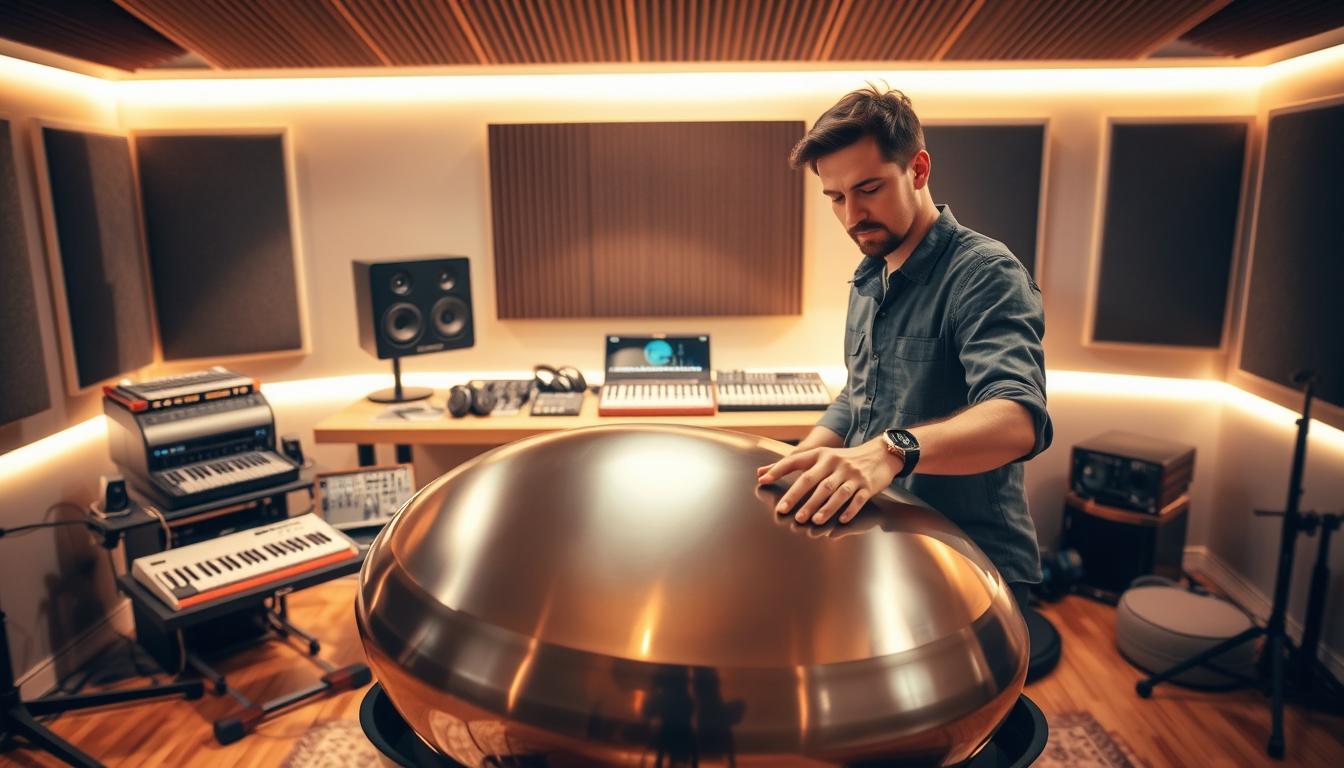
In the studio, its versatility comes from ready-to-use sounds, presets and built-in effects. USB‑C audio/MIDI lets you record directly into a DAW on a computer and capture a clean take without a microphone.
- Record an ambient loop while wearing headphones.
- Layer parts and control a synth via MIDI.
- Quickly produce a demo without searching for the ideal room.
“It saves time: fewer microphones to position and less dependence on room acoustics.”
One limitation: the feel does not always match the vibrating steel of a traditional instrument; the final quality depends heavily on the sound libraries and the pads’ dynamic response.
Product overview: Roland Mood Pan MN‑10 design, ergonomics and first steps
This model focuses on immediate playability and a clear layout. Its design favors simplicity: nine responsive pads are arranged so you can play without advanced music theory. Start playing right away, without complicated settings.
The pads are assigned to preprogrammed scales, which prevents wrong notes and reassures beginners. The control area turns small gestures into changes in volume, effects or pitch.
As for portability, the Mood Pan measures 316 × 94 mm and weighs 2.4 kg with batteries. It is light enough to carry between home, a yoga class and a rehearsal.
- Nine pads: precise playing and variations in attack.
- Control area: expressive nuances without interrupting play.
- Preset scales: confident playing for everyone.
| Feature | Specification | Practical effect |
|---|---|---|
| Pads | 9 responsive pads | Precise playing and varied dynamics |
| Dimensions | 316 × 94 mm | Easy to carry and place on a table |
| Weight | 2.4 kg (with batteries) | Relatively easy to carry |
| Protection against mistakes | Preset scales | No wrong notes |
“A product designed to be accessible: ideal if you want to compose quickly without technical hurdles.”
Sound options: tones, scales, tuning and built-in effects
The MN‑10’s sound palette covers thirteen ready-to-play textures, from singing bowls to modern synthesizers. These sounds include tongue drum, gamelan, crystal bowls, sitar and strings. They let you move from an acoustic character to more electronic layers for ambient music or soundtracks.
Changing scales is quick: tuning ranges from 415.3 to 466.2 Hz, with direct access to 432, 440 and 528 Hz. This flexibility makes it easier to accompany another musician or adapt a wellness session to a desired frequency.
The built-in effects—reverb, delay, phaser, pitch, Auto Wah and ring modulation—let you shape depth and movement without a plugin. Combining them gives you a sound design tool ready for production.
Customization: the app provides four user slots for saving presets and organizing settings by session, such as yoga, composition or live performance. You can quickly recall your preferred setup.
“Thirteen sounds and varied effects: ideal for exploring soundscapes without needing multiple instruments.”
A practical limitation: the number of playable notes often remains at 9 or 10, depending on the setup. You may therefore need to change the scale to reach a wider range.
For technical specifications and compatible sounds, see the manufacturer’s pages, which explain sound quality and advanced use.
Listening, resonance and monitoring: built-in speaker, headphones and audio output
Being able to try an instrument without extra equipment is appealing, but expectations should remain realistic. The built-in speaker provides immediate listening and lets you use the device on its own.
The MN‑10 has a 2.1 system with a total output of 4.5 W (1.2 W × 2 + 2.1 W). Two 3.5 × 8 cm speakers and a 10 cm woofer strengthen bass resonance. The sound thus has more body than a typical small speaker, although it cannot match reference monitors.
To play late at night or assess attacks and effects closely, switch to headphones. The 1/8″ stereo PHONES/OUTPUT jack also lets you connect an interface, PA system or better speaker to judge sound quality.
In practice, use the speaker to compose and test ideas. Switch to headphones or monitors to finish a mix. Some competing models have no speaker: they are therefore less useful on their own and create a need for additional accessories.
“Listen through the speaker first, then check your choices on headphones or monitors.”
Studio connectivity and computer integration: USB‑C audio/MIDI, Bluetooth and BLE MIDI
Connecting to a computer is simple: the MN‑10 has a native USB‑C audio/MIDI port that lets you record directly into a DAW, often without an interface. This connection shortens the audio chain, limits noise and avoids complicated microphone setups.
MIDI recording lets you edit timing and velocity. You can also control virtual instruments to expand your sounds or create textures from your playing gestures.
Bluetooth 4.2 A2DP lets you play backing tracks from a phone and improvise without a cable. BLE MIDI (GATT) makes it easier to control mobile apps and composition software during a performance or session.
The Mood Pan Plus app (iOS/Android) lets you load sounds, save presets and adjust pad sensitivity. You can tailor the response to your touch and the way you use the instrument in production.
“For serious studio work, prioritize USB‑C and a good listening setup; try Bluetooth for quick sessions.”
Battery life, power and portable use: what to plan before buying
Battery life remains a key consideration when playing away from home.
Key figures: the MN‑10 uses six AA batteries. Expect up to 5 hours with Ni‑MH batteries and around 4 hours with alkaline batteries. Average current draw is about 400 mA. Avoid manganese batteries: they do not last long.
For longer power supply, USB‑C is useful. Use an adapter rated at least 9 V/2 A or a compatible power bank to play longer.
Plan the accessories you need before buying: headphones for quiet playing, USB‑C cables and, perhaps, an external speaker for workshops or small concerts.
Portability depends on the model: a built-in speaker lets you play immediately; without one, you need headphones or a charged speaker. Bring good rechargeable Ni‑MH batteries and a spare set.
| Item | Specification | Advice |
|---|---|---|
| Batteries | 6 AA batteries | Ni‑MH recommended (up to 5 hours) |
| Running time | About 5 hours (Ni‑MH) / 4 hours (alkaline) | Test according to volume and effects use |
| USB‑C | Adapter rated at least 9 V/2 A | Allows extended playing on mains power or a power bank |
| Accessories | Headphones, cables, speaker | Prepare accessories according to your needs while traveling |
“No power, no sound: check real battery life for your intended uses before buying.”
Price, availability, durability and alternatives: choosing a model in France
The French market for these digital instruments remains small and changeable. Models are available, but few retailers keep Oval, Lumen, WavePan or Neotone in stock for long. Purchases are often made directly from the manufacturer, with varying lead times.
As a result, prices are not always stable. Expect prices to start at around €1,500, while some models, such as Neotone, are around €3,000 to €4,000. This range reflects their versatility: multiple scales, sounds and USB/MIDI/Bluetooth connectivity.
Risks to bear in mind include uncertain after-sales support, scarce spare parts and aging batteries. Some projects are paused or discontinued, affecting long-term durability.
- Advantage: one device covers several scales and replaces several instruments.
- Limitation: an electronic fault can be difficult to repair.
Compared with a traditional acoustic handpan, the electronic model makes recording easier and offers more flexibility. The acoustic model retains the advantages of longevity and simple maintenance.
Points to check before buying: whether it has a speaker, output quality, DAW compatibility, warranty terms, spare parts availability and independent customer reviews.
| Criterion | What to check | Practical effect |
|---|---|---|
| Typical price | From around €1,500 (depending on the brand) | Midrange to premium positioning |
| Availability | Direct sales are common; stock is limited | Varying lead times and after-sales support |
| Durability | Electronic components and batteries | Risk of failure and scarce parts |
| Added value | Multiple scales, effects and connectivity | Useful composition features |
Conclusion
Overall, this type of modern device makes creating and recording contemporary music easier. The Roland Mood Pan MN‑10 illustrates that promise: 9 pads, a control area, 13 sounds, a 2.1 speaker (4.5 W), a 1/8″ PHONES/OUTPUT jack and a USB‑C audio/MIDI port for connecting it to a computer or DAW.
Choose according to your priorities: playing feel, sound quality, ease of recording, connectivity and fit with your workflow. Account for practical limitations: dependence on power, limited battery life, and questions about durability and after-sales support.
If you want versatility, quick recording and ready-to-use soundscapes, this type of instrument remains an excellent choice. For a full view of the benefits and risks, read our detailed analysis.