Why does this question keep coming up? The terminology has changed with history, law and the market. The original instrument, created in 2000 by Felix Rohner and Sabina Schärer at PANArt, gained substantial legal protection. The words sellers use are therefore no longer neutral.
What you will learn: by the end of this article, you will know what to call the instrument and understand its origins, construction, sound and effect on price.
We are comparing a specific instrument associated with PANArt with a family of instruments inspired by it. They share visual features (dome, Ding and tone fields), but their legal, material and commercial differences are real.
Warning: using the protected name to sell another instrument can mislead buyers and carry risks. For a detailed analysis, follow the guide.
Hang, Hang Drum and handpan: clear definitions to avoid confusion
PANArt created a particular instrument; the market later named its successors. This distinction matters when buying, repairing and talking with other musicians.
Why “Hang” refers to a particular instrument
Hang is the name of a historic instrument associated with PANArt Hangbau AG. It is an original, protected instrument recognizable by its construction. Using the term for every metal instrument played with bare hands can cause confusion.
The role of the popular term “Hang Drum”
“Hang Drum” is common in listings, but imprecise. PANArt instead calls its creation a sound sculpture and prefers “Hang.” The popular term remains mainly a descriptive label.
What does handpan mean in the marketplace?
Handpan has become the generic term for a family of steel instruments played with bare hands and inspired by the original concept. It covers a wide variety of construction methods.
- The Hang can be considered the archetype.
- Handpans include many contemporary instruments.
- In practice, if PANArt did not make the instrument, it is generally called a handpan.
In a listing or on an invoice, the terms used often determine what you are buying. To compare other percussion instruments and broaden your search, read everything you need to know about the tongue drum.
Hang vs. handpan: what really differs
The key point in one sentence: the Hang is a specific instrument associated with PANArt; handpan refers to contemporary instruments made by various makers.
What you will see: shape and construction vary, including the curves, the Ding’s proportions, the arrangement of the tone fields and sometimes the Gu opening.
What you will hear: differences in timbre, harmonic balance, sustain and the character of the central bass note.
What you will pay: an original is rare and often more expensive; handpan prices vary widely with the material, construction time and maker’s reputation.
“A seller advertising a ‘Hang’ without proof that it came from PANArt should make buyers cautious.”
| Aspect | Appearance | Sound | Price |
|---|---|---|---|
| Original | Historic proportions, distinctive Ding | Specific sound signature and sustain | Rarity → high price |
| Contemporary instruments | Variations in shape and design | Wide range of sound signatures | Availability → highly variable prices |
| Buying check | Verify its origin and maker | Listen in person or to a clear recording | Compare warranties and reputations |
Why this matters more today: legal pressure since 2020 and a July 2024 ruling have encouraged makers to distinguish their instruments, making the boundary between resemblance and identity clearer.
- Check these details in a listing: origin, material, tuning, service, condition and whether the name is accurate.
Next: a return to the instrument’s origins in 2000, followed by its legal and technical context.
Origins and history: from the Hang’s creation in Switzerland to modern copies
The story begins in Switzerland, where two craftspeople reimagined a steel instrument for playing with bare hands.
2000: Felix Rohner and Sabina Schärer at PANArt designed an instrument with a distinctive dome. Its construction includes a central Ding, tone fields and a Gu opening. This innovation combines appearance and acoustics.
Production was deliberately limited: around 400 instruments a year, according to reports. Buyers had to write a letter of motivation and travel to Switzerland. This scarcity enhanced the instrument’s mystique.
Rising demand quickly created a gap in the market. Others responded with similar alternatives. Some makers developed their skills and diversified their instruments. Others copied the appearance without adding innovations.
“When supply is limited, the market finds answers: new factories, new craftspeople and new names.”
| Year | Event | Result |
|---|---|---|
| 2000 | Created by PANArt (Rohner & Schärer) | The birth of the original instrument |
| 2000s–2010s | Limited production and strict buying conditions | Scarcity and increased demand |
| Late 2000s | Alternative makers appeared | A diverse market emerged |
Construction time: craftsmanship takes weeks, sometimes months. This partly explains the tension between supply and demand.
Legal context: trademark, intellectual property and the impact on makers
Legal debates over the instrument’s name and shape have reshaped the market in recent years.
2008: international registration of the name
In 2008, the name was registered as a trademark internationally. The result: other parties faced restrictions on its commercial use.
Since 2020: legal proceedings and closures
From 2020, PANArt began legal proceedings, especially in German-speaking markets. Several sellers and makers received formal notices. Some closed or changed their listings.
July 2024: recognition as a work
The Bern court classified the instrument as a sound sculpture and granted it copyright protection. Such a ruling is rare for a musical instrument.
“The ruling highlights that copyright may protect the shape, not just the name.”
Two legal concepts coexist and affect the industry: a trademark protects the name, while copyright protects the creation. Both can restrict commercial use and encourage makers to vary the shape and certain details.
- More effort to distinguish the outlines of different instruments.
- Reworded product names to avoid confusion.
- For buyers: favor transparent makers and verify an instrument’s origin.
The precise scope of protection remains debated. Meanwhile, local makers are adjusting their designs, and the market offers more visible variation. To explore options from established producers, see local makers.
Visible physical differences: shape, surface and sound architecture
Looking closely at an instrument reveals clues about its sound architecture and identity.
The historic lens shape and flatter designs
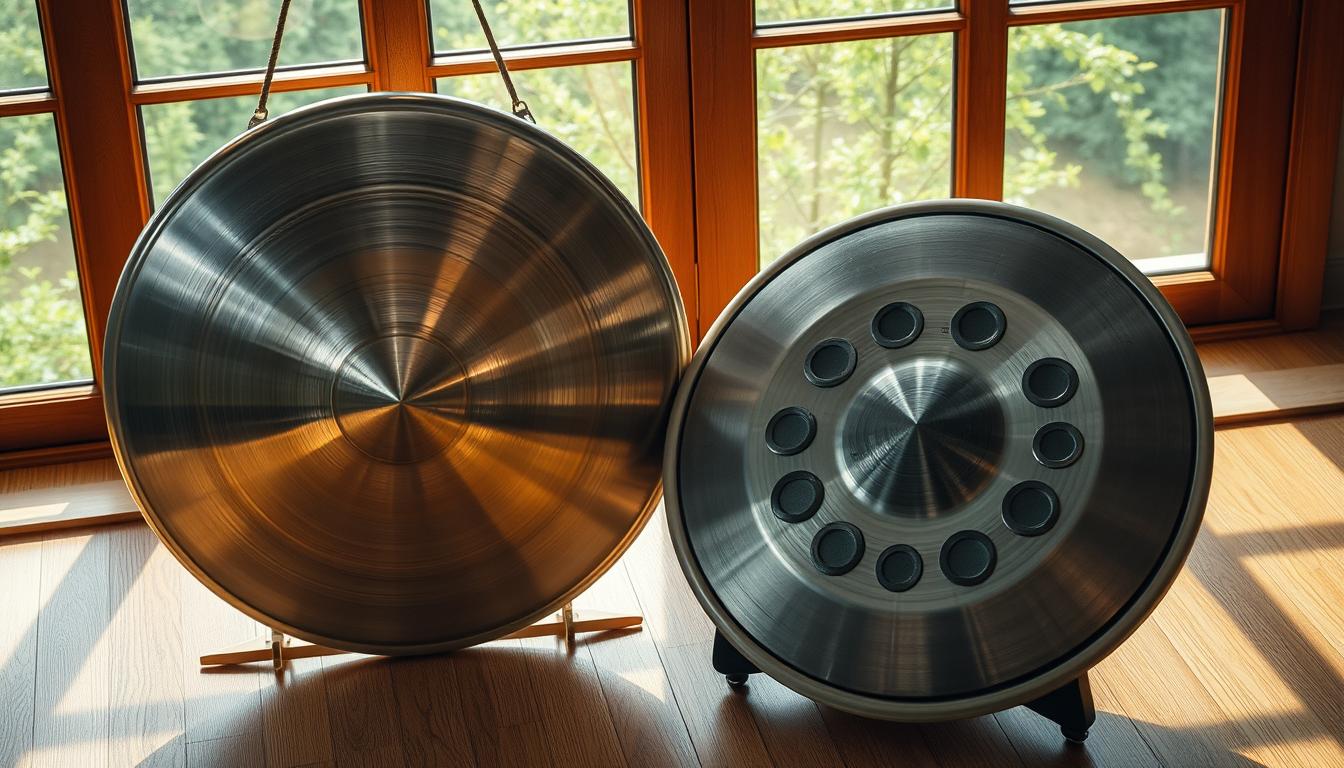
The so-called “lens” shape remains the archetype’s most recognizable feature. It has a noticeably raised dome and curved shells.
Some contemporary instruments are flatter or rounder. These variations affect projection and how the instrument feels to play.
The central Ding and tone fields
The Ding provides the bass note and a visual focal point. Its height and profile vary by maker.
Around it, tone fields differ in dimple depth, the smoothness of their transitions and the precision of their shaping. These choices affect touch response and harmonic clarity.
The Gu and projection
The chamber underneath the instrument, the Gu, affects volume and the sound’s “breathing.” A larger opening often provides more projection.
Simple things to check: overall outline, dome height, consistency of the fields, surface finish and alignment of the edges.
Market: legal pressure is pushing makers to diversify their instruments. The result is a wider visual and acoustic range for musicians.
Materials and treatments: pang, nitrided steel, stainless steel and ember steel
The material shapes durability, feel and tonal color. It affects corrosion resistance, the feel under your fingers, tuning stability and sound.
Pang: the steel associated with PANArt
Pang refers to the historic steel associated with PANArt’s original instrument. It is often cited as a sign of authenticity. Its finish and treatment contribute to the instrument’s sound signature and appearance.
Nitrided steel: a common material
Many modern handpans use nitrided steel. Nitriding hardens the surface and reduces initial oxidation.
However, without maintenance, humidity and salty air encourage corrosion. You still need to oil and dry the instrument and store it in a protected place.
Stainless steel and ember steel: alternatives
Stainless steel appeals to players in humid environments. It can change the timbre and offers greater durability during transport.
Ember steel is a more recent option intended to balance responsiveness, sustain and strength.
- Advice for reading listings: insist that the material and treatment be specified.
- Match the material to your playing style: some prefer an airy sound, while others want a response that is easier to control.
Coming up: a closer look at construction and tuning.
Construction and working time: how craftsmanship affects quality
Good sound often comes from repeated skilled actions and a maker’s precise control of the metal.
The heart of the craft lies in hammering, shaping and heat treatment. Each hammer strike changes the membrane and the structure of its fundamental and harmonics. Mastery of these steps determines tuning accuracy and richness of timbre.
Hammering, cutting and shaping
Cutting is more relevant to instruments with tongues. Here, the shape is created by hammering. This work affects curvature, tension and the responsiveness of the tone fields.
In other words, precision in the work matters more than the outer shape alone.
Tuning note by note
Tuning is an iterative process: the maker adjusts each note, listens again and makes further changes. This work can take weeks, sometimes months.
Two instruments identical on paper can sound different depending on the maker’s experience and the support offered after construction.
Stability, fragility and risks
An impact, high heat or moisture can knock the instrument out of tune or corrode its surface. Salt speeds up corrosion.
“Do not try to retune the instrument yourself: an incorrect adjustment often makes the problem worse.”
| Stage | Impact | Recommendation |
|---|---|---|
| Hammering | Control of timbre and harmonics | Entrust the work to an experienced craftsperson |
| Fine tuning | Lengthy work and gradual stabilization | Allow for follow-up and be patient |
| Exposure | Risks of detuning and corrosion | Avoid sun, salt and impacts; use a case |
- Transport: choose a padded case.
- Handling: play with your hands and avoid hard surfaces.
- Service: choose a maker who offers a warranty and retuning.
For another example of workshop construction and ongoing craftsmanship, discover the workshop-made guitar.
Sound: sustain, resonance, harmonics and musical “signature”
Sustain and resonance shape an instrument’s signature.
Clarity and harmonics: what musicians seek
Attack clarity, the balance between the fundamental and the harmonics, and clear resonances are key criteria.
Musicians often look for consistency: no unwanted harmonics, clean attacks and a stable underlying sound.
Resonance and sustain: today’s variations
Some instruments favor long, immersive resonance. Others aim for a drier response, useful in a studio or on stage.
That choice affects the dynamics of playing and the instrument’s place in a piece of music.
The Ding’s role: bass, dynamics and volume
The Ding anchors the instrument’s range. A stable bass note strengthens the sense of volume and its overall sound identity.
- Simple test: play each note alone, then play sequences.
- Listen for beating and compare the sustain of different fields.
- Check whether unwanted harmonics interfere with the resonance.
Buying advice: do not rely only on a compressed video. Listen to the instrument in person or with headphones, or compare several instruments in the same room.
“A stable Ding changes everything: it turns a series of notes into a distinctive sound.”
Next are the scale and number of notes, two features that complete this sound identity.
udus and percussion instruments
Notes, scales and number of tone fields: what are the limits and options?
A smaller set of notes makes improvisation easier; a larger one opens up more compositional possibilities.
Most instruments have a simple layout. The upper face often has 7 to 10 notes. This reduces the risk of “wrong notes” and encourages intuitive playing.
Extended instruments add tone fields, sometimes underneath the shell. Some have up to around 21 notes. That provides more harmonic colors but requires greater skill.
Choose a scale for your needs
Improvisation: choose a small, simple and inspiring scale.
Composition: a broader range allows richer harmonic combinations.
A practical method
- First define how you will use the instrument (meditation, performance or writing).
- Choose a scale for its emotional character.
- Choose the number of notes according to your technical confidence.
| Option | Advantage | Disadvantage |
|---|---|---|
| 7 to 10 notes | Easy to play; encourages improvisation | Less harmonic variety |
| 11 to 21 notes | More compositional possibilities | More complex tuning and playing |
| Tuning (440 or 432 Hz) | 440 Hz: compatibility; 432 Hz: relaxation | 432 Hz: requires a dedicated instrument |
Practical note: more notes often mean a higher price and more demanding tuning.
Prices, availability and the French market: what to expect
Prices and availability for these instruments vary greatly in the French market.
Observed price ranges: a handmade handpan often sells for €800 to €2,500. Some premium instruments cost more, depending on the maker’s reputation.
Why a good instrument costs so much: construction time, manual tuning, rejected pieces and quality control explain high prices. After-sales service (warranty and retuning) also matters.
Scarcity and variety
The Hang remains very rare and has always been difficult to obtain. The handpan market is much larger, with many makers, waiting lists and secondhand offers.
| Factor | Effect on price | Example |
|---|---|---|
| Material (steel, stainless steel) | Changes durability and timbre | Nitrided steel: common |
| Finish and complexity | Extra work and time | More notes = higher cost |
| Maker’s reputation | Reputation premium | Well-known makers: higher prices |
Tips for reading a listing: check the maker’s identity and the material, ask about retuning needs and request unprocessed recordings. Be wary of unusually cheap “bargains”: they can conceal an unstable or poorly tuned instrument.
Add a case, maintenance and possible retuning to your budget to estimate the total cost. Follow this link for a detailed analysis of the market.
How to choose between two similar instruments: quick decision criteria
When comparing two similar offers, a few simple criteria can help you decide. Use this checklist to guide your choice according to your skill level, intended use and environment.
By skill level
Beginner: favor a stable instrument, a simple scale and an affordable price.
Intermediate: choose more notes and better dynamics.
Advanced: look for a distinctive sound, good projection and precise tuning.
By intended use
Studio: controlled harmonics and clean sustain.
Stage: projection and playing comfort.
Daily practice: durability and easy maintenance.
Relaxation: a gentle timbre and long sustain.
By environment
If humidity or salty air is a concern, favor stainless steel or an anticorrosion treatment.
Avoid impacts, direct heat and extreme changes that can detune the instrument.
Common mistakes to avoid
- Believing marketing claims without listening to a recording.
- Overlooking tuning accuracy and the balance between notes.
- Buying without knowing the material or maintenance history.
| What to check | Why | Action |
|---|---|---|
| Consistency between notes | Helps detect beating | Ask for unprocessed recordings |
| Quality of the finish | Shows the maker’s attention to detail | Examine photos and the instrument’s condition |
| Return terms | Important for a remote purchase | Favor a warranty and clear terms |
Practical test: play gently with your hand. A good instrument responds without harshness or unwanted resonances.
A precaution: if the seller will not specify the material or tuning, or send clear recordings, move on. To find a reputable maker, favor transparency and after-sales service.
Care and accessories: protect the surface and preserve tuning over time
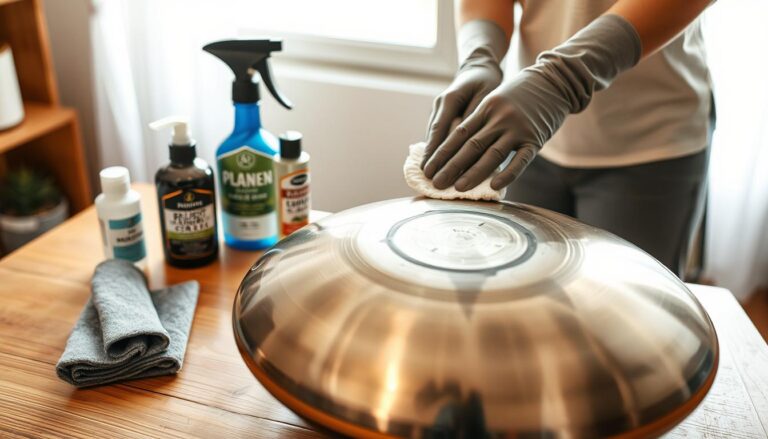
Protecting the surface and preserving tuning take simple, regular steps. After each session, wipe the instrument to remove sweat and moisture. This prevents corrosion of the steel and limits marks that can affect timbre.
Humidity, salt and heat: good everyday practices
Humidity and salty air speed up rust formation. Maintain the instrument more often near the sea.
Heat and direct sunlight can destabilize tuning. Avoid sudden temperature changes and do not leave the instrument in the sun.
Bags, cases, stands and oils: essentials for longevity
A basic set of accessories protects your instrument: a padded bag or hard case, soft cloths, suitable protective oil and desiccant packets. A stable stand improves playing comfort and projection.
- Simple routine: wipe the surface, oil it lightly if needed and store the instrument somewhere dry.
- Transport: use a padded case and avoid abrasive surfaces.
- Playing: use your hands; avoid hard blows and unsuitable mallets.
When should you seek a professional inspection or retuning?
Consult a professional if a note wavers, beating appears, sustain decreases or the instrument has been struck. Do not attempt to retune the whole instrument yourself: a mistake can make the problem worse.
Periodic inspection can catch tuning drift early and avoid lengthy, expensive repairs.
Benefits: a well-maintained instrument retains its tuning and resale value and remains reliable for playing and percussion. For advice on protection from heat and cold, see our complete guide: protect your instrument.
Conclusion
In summary: the Hang, an instrument protected by PANArt, remains a historic original, while handpan now describes a broad family of instruments made by various craftspeople. These legal and construction differences affect your purchase.
Three things matter to a buyer: terminology, so you know what you are paying for; availability and price, shaped by scarcity or supply; and design changes arising from the legal context.
Be practical: examine the shape, material, tuning quality, stability, number of notes and fit with your musical aims. Listen to several instruments, ask for technical details and favor sellers who are transparent.
With these criteria, most buyers can find a reliable, inspiring and durable instrument for their music.