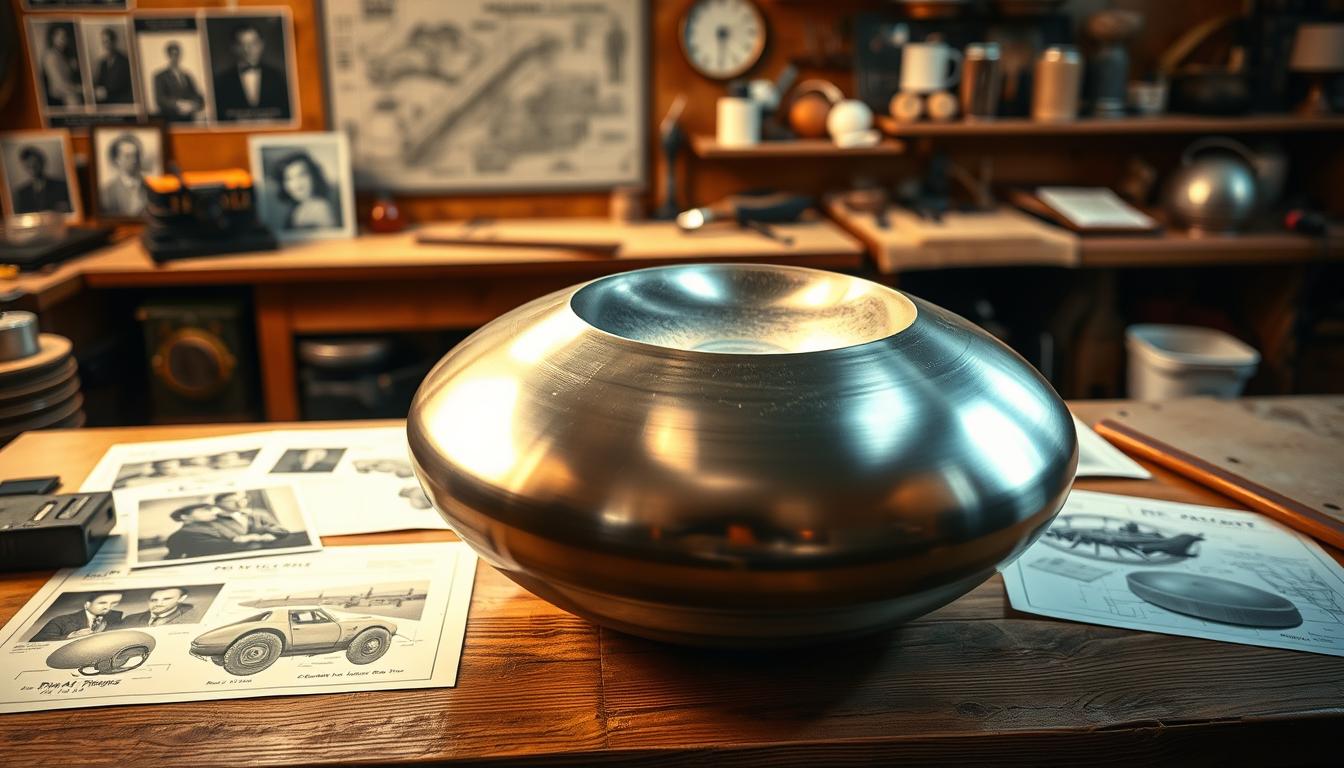
Brief introduction: This guide traces the origins of a distinctive sound instrument and its adoption by musicians around the world.
The origin and history of the handpan begin in Bern, where the Hang® was created in 2000.
Felix Rohner and Sabina Schärer of PANArt drew inspiration from the steelpan and the ghatam to create a new sound. The name PANArt Hangbau reflects their artisanal approach.
We offer a clear account: Caribbean roots, decisive developments from 1976 to 2000, its spread during the 2000s, and the adoption of the word “handpan.”
You will learn why the names are often confused, how the scarcity of PANArt instruments shaped the market, and why this UFO-shaped object became a sought-after instrument for improvisation and melodic percussion.
Understanding the handpan, the Hang and the “Hang Drum”: definition and key features
To understand this instrument, start with its acoustic nature and distinctive shape. It is a steel idiophone made of two joined convex shells, often described as a sound-producing lens.
A steel idiophone percussion instrument played by hand
The now-common term “Hang Drum” can be misleading: the instrument is played with the hands, not with sticks. Its original maker advises against using sticks.
The sound-producing “lens”: two joined convex shells
The upper half has a central ding surrounded by hammered areas that produce the notes. These areas form tuned tone fields that resonate when struck gently by hand.
Notes, the central ding, scales and the impression that there are “no wrong notes”
The instrument is tuned to a single scale, making improvisation easier and creating the impression that there are “no wrong notes.” Its layout, with a central ding and a circle of notes, shapes both the playing technique and the sound.
The Gu opening and the Helmholtz effect: when the instrument also becomes an udu drum
Some models have a “Gu” opening. The cavity produces Helmholtz-type resonance that can be changed by opening or closing the hole, somewhat like an udu. This movement changes the bass frequencies and broadens the rhythmic palette.
“An instrument that combines percussion and melody through intuitive hand playing.”
To explore its origins and the transition to today’s instrument family, read more about this heritage.
Before the Hang: the steelpan’s Caribbean roots and the legacy of steel drums
The steelpan’s history begins in the streets of the Caribbean, where ingenuity transformed barrels into musical instruments.
In twentieth-century Trinidad and Tobago, these steel drums quickly became tuned idiophones. The earliest models emerged from a community tradition and were often tuned “by ear” by local craftspeople.
Methods gradually evolved. Tuners introduced harmonics—first the octave, then the compound fifth—to improve timbre, pitch accuracy and sustain. This move towards modern standards aimed to make the sound more stable and improve its quality.
The steelpan influenced the creation of the handpan through its use of steel, hammered surfaces and tone fields. The new instrument reinterprets these techniques for more intimate hand playing.
“A Caribbean heritage that provided a technical and musical foundation for European innovations.”
| Stage | Period | Technique | Impact |
|---|---|---|---|
| Community origins | Early twentieth century | Tuning by ear | Creation of local idiophones |
| Standardization | Mid-twentieth century | Adding harmonics | Improved timbre and stability |
| Transmission | 1970s to 1990s | Surface shaping and hammering | Inspiration for new instruments |
The creators: Felix Rohner and Sabina Schärer, from a Bern workshop to PANArt
In their Bern workshop, two craftspeople turned their passion for steel into a focused search for sound.
1976 marked a turning point: Felix Rohner discovered the steel drum and began a long exploration of tuned steel’s possibilities.
1976: encountering the steel drum
This first encounter prompted technical experiments. Rohner measured and hammered steel, recording differences in timbre. These early steps laid the groundwork for a rigorous artisanal approach.
1993–1995: founding the workshop and welcoming a partner
On May 12, 1993, he founded PANArt Steelpan Manufaktur SA. Around 1995, Sabina Schärer joined the team, and the pair developed a shared vision.
The artisanal choice: making, precision and research
Together, Felix Rohner and Sabina Schärer emphasized making, tuning and consistency. They developed a nitrided steel, later called Pang, and established research methods.
“Creators who combined craft and science to master the sensitivity of an instrument played by hand.”
To learn more about their journey and PANArt’s gradual development, read the history of PANArt.
From idea to prototype: Reto Weber’s spark and the influence of the ghatam
In November 1999, an unexpected visit set off a series of sound experiments. Reto Weber brought a ghatam and suggested a “metal ghatam.” The idea began a period of intense creative work.
Why the ghatam? Playing with bare hands, its percussive richness and the importance of its cavity all drew attention. The makers sought to preserve that expressiveness while moving to steel.
Prototypes and intersecting influences
They tested different approaches to hammering, treatments and the shapes of the note fields. Many instruments inspired them:
- Tabla — attack and precision.
- Gamelan — harmonic power.
- Drums and bells — sound envelope and sustain.
- Tuning forks — purity of frequencies.
The chosen shape
After studying the acoustic structure, the team chose a shape made of two joined convex shells. This lens provides structural rigidity, separates the tone fields and projects the sound.
“A sound-producing vessel reimagined for the hands: a circular layout, note placement and playing comfort became decisive criteria.”
The prototype, refined for circular playing and sound projection, was ready to be shown to the public. The next step was the instrument’s official birth and naming.
The birth of PANArt’s Hang: 2000, early generations and worldwide spread
In 2000, a Swiss sound instrument took shape, driven by the search for a new playing layout and timbre.
The completed model favored hand playing, a two-shell structure and a gentle range of sounds for improvisation.
Origin of the name
“Hang” comes from the Bernese dialect and refers to the hand, and sometimes to the idea of a hill, in connection with its convex shape.
Musikmesse 2001 and its spread
Many musicians saw its presentation in Frankfurt in 2001 as a revelation.
A distribution network soon brought it to audiences around the world.
2000–2005: creativity and materials
During this period, about 45 scales and configurations appeared. PANArt worked with nitrided steel called Pang.
Making remained artisanal, production was limited, and the pursuit of quality took time.
| Period | Production | Variations | Impact |
|---|---|---|---|
| 2000 | Completed prototype | Shape and central ding | Public launch |
| 2001 | Distribution begins | International visibility | Musicians’ interest |
| 2000–2005 | Limited production | About 45 scales | Worldwide spread |
“An artisanal creation that won over the world through its rich sound and ease of playing.”
Origin of the handpan: its history, PANArt and the instrument’s evolution
The shift in 2003 reflected a desire to establish an identity around an instrument played by hand. The 2003 name change confirmed the Hang’s central place in the company’s production and brand identity.
2003: a name for a mission
The administrative restructuring and change in branding followed a straightforward goal: focus the business on this distinctive instrument. The new name signaled specialization and the importance of protecting it.
2005–2006: viral popularity and pressure
Videos on YouTube and social media drove a sharp rise in demand. This worldwide visibility put artisanal production under strain.
Slow, manual production could not meet sudden worldwide demand. The result was waiting lists and speculation.
Sales strategy and control
To limit resale, PANArt concentrated sales in Switzerland. The company required a letter explaining the buyer’s interest and imposed clauses against resale.
“Limiting commercial distribution was intended to preserve direct contact with musicians and sound quality.”
Pauses, research and quality
Planned pauses were devoted to research and development. The goal was to improve tuning and note stability.
This pursuit of quality made the sound more consistent from one instrument to another and contributed to their scarcity.
| Year | Event | Consequence |
|---|---|---|
| 2003 | Official name change | Identity centered on the model |
| 2005–2006 | Online popularity spreads rapidly | Increased worldwide demand |
| From 2006 | Controlled sales | Scarcity, waiting lists, protection of the name |
From Hang to “handpan”: the term’s emergence, copies and other makers
The need for a generic term became clear as instruments with a similar shape and sound multiplied beyond the original workshop.
Why PANArt rejects generic use of its name
PANArt protected the name to preserve its model’s identity and quality. The strategy sought to distinguish the original instrument from copies and control its sale.
2007: the birth of a generic term
In 2007, Kyle Cox of Pantheon Steel proposed “handpan” as a name for this family of instruments. The word groups hand-played variants into one instrument family.
Replicas and alternative names
Other makers soon produced competing versions. Names such as Caisa, Halo, Bells and Spacedrum appeared.
The term pantam also circulates, often suggesting a lineage or sound style. “UFO drum” remains a descriptive nickname among the general public.
“The term ‘Hang Drum’ remains common in searches, but the community mostly uses the generic term proposed in 2007.”
To avoid confusion when buying or researching one, use Hang for the original instrument and prefer the generic term for the family made by other makers.
Modern evolution: tuning, quality, innovations and similar instruments
Recent developments emphasize precise frequency relationships to improve the character of the sound.
The 1:2:3 harmonic relationship
The 1:2:3 relationship corresponds to the fundamental, octave and compound fifth. This tuning encourages a rich, stable sound that is easy to harmonize.
The listener hears a clear attack, a rounded body and harmonics that support the scale. In musical practice, this creates the impression that there are “no wrong notes.”
Stability and shoulder tones
Stable tuning and balance between notes limit interference. Makers seek controlled sustain without unwanted vibrations.
Shoulder tones are additional harmonics that add color. They enrich the timbre but do not guarantee quality on their own.
Innovations: structure and electronic versions
More notes, alternative layouts, a double Gu and electronic versions expand the possibilities for expression. Electronic models offer effects and flexibility without replacing acoustic vibration.
Similar instruments
The steel tongue drum and other steel idiophones offer a different approach: their construction, dynamics, projection and prices vary.
How to recognize good craftsmanship
- Consistent timbre across the notes
- Controlled sustain and stable pitch
- No unwanted noise
- Careful finishing and makers with good reputations
- After-sales service and the option of retuning
“The market now includes a great many makers: choosing an instrument calls for technical criteria and attentive listening.”
| Criterion | Indicator | Why does it matter? |
|---|---|---|
| Tuning | 1:2:3 relationship and accurate pitch | Supports harmonic richness and stability |
| Stability | Controlled sustain | Reduces interference between notes |
| Finish | Surface, seam and Gu opening | Affects projection and durability |
| Ongoing support | Retuning and warranty | Preserves quality over time |
To explore the historical differences and choices in making these instruments, see this article.
Conclusion
The meeting of workshop craft and tradition transformed a Caribbean heritage and the idea of the ghatam into an instrument played by hand.
In summary: worked steel, a central ding, tuned areas and sometimes a Gu form the basis of this instrument. Its spread online expanded the instrument family and accelerated its adoption.
Today, its history stretches from a rare artisanal model to a vibrant scene of makers and innovations. When choosing one, prioritize quality, accurate tuning, stability and ongoing support over visual appeal alone.
Listen to several scales, compare how the instruments feel to play, and learn about their making and origins before buying; this approach protects your investment and enriches your musical practice.