Guide objective: produce a clear sound, avoid metallic tones, play more fluidly and master the movements without strain. This practical guide shows you how to develop touch, dynamics and resonance for expressive playing.
Why take a subtle approach? Every contact changes the resonance, perceived pitch and musical flow. A light touch produces a clear main note and clean resonance.
The learning progression moves from the basics — posture, touch and dynamics — to rebound, then rolls and ghost notes, before covering percussive effects and complex patterns.
This guide is for motivated beginners and intermediate players. Use short exercises, a metronome, active listening and recordings to speed up your learning.
What you can achieve: greater musical depth, clear notes and steady speed through rebound and alternating hands.
Understanding the handpan and what makes a good sound
Understanding how the instrument is built and responds is the key to playing clearly.
Structure and layout of the playing surface
The steel shell has shaped areas for each note. The surface has a central dome and surrounding note areas. This layout guides melodic sequences and makes hand movements easier.
Force and a light touch
Sound quality comes from a clean attack and long resonance. An aggressive strike often creates a metallic click and weakens the harmonics.
Exploring how the instrument responds
Play each note on its own, listen to its resonance and compare the central dome with the surrounding areas. Some areas sound distorted if you strike too hard. Knowing how the instrument responds helps you adjust your force and avoid distortion.
Measurable goals
Aim: produce clearer notes, smoother transitions, a steady tempo and expressive dynamics. The next step covers posture and relaxed hands, which are essential for rebound and rolls.
Posture, hand position and relaxation for precise playing
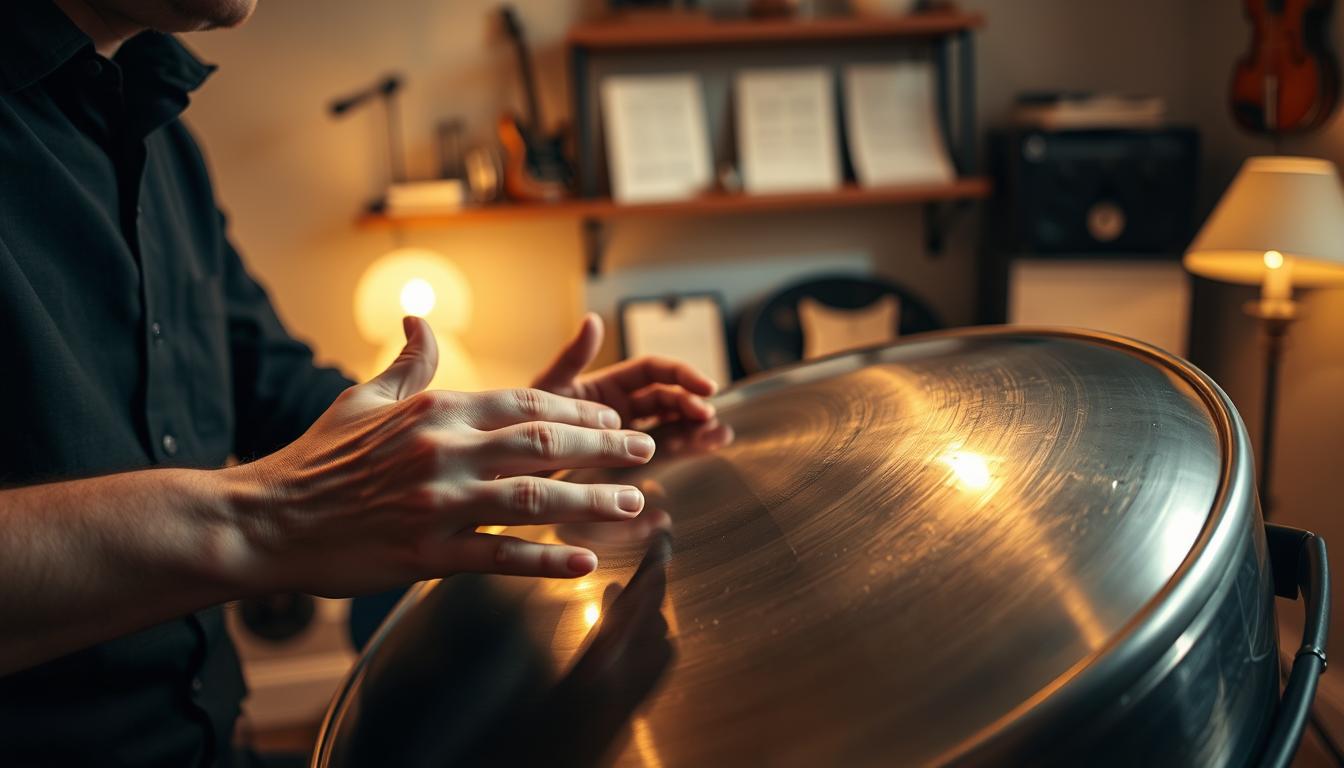
A stable setup and a relaxed body make precision easier. Sit on a chair or cushion and keep your back straight without stiffening it. Centre the instrument on your lap or place it on a stand, whichever feels more comfortable.
Seated position and access
Playing on your lap gives you more freedom to move. A stand provides greater stability and easier access to the edges for percussive strikes. Adjust the height so you can reach every area without raising your shoulders.
Relaxing your wrists and fingers
Keep your elbows close to your body and your wrists flexible. Your fingers should be ready to touch and lift away, without pressing down. Striking and then withdrawing quickly prevents the sound from becoming muddy.
- Relaxation routine: rotate your wrists, shake out your hands and breathe slowly.
- Common problems: bent wrists, stiff fingers and raised shoulders — film yourself for 30 seconds to spot and correct them.
Gentle touch and dynamics to add nuance to your music
Controlled touch turns a simple strike into a nuanced musical gesture. Aim for a brief, controlled fingertip attack rather than a heavy strike. This keeps the note clear and improves your dynamics.
Fingertips, contact speed and volume control
The speed of impact affects volume without requiring more force. A quick, precise attack gives the note presence while remaining gentle. Experiment to feel how dynamics change with speed.
Practising soft and loud strikes on the same note
Simple exercise: choose each note in turn and play eight very soft strikes, then eight stronger strikes, at the same tempo. Next, play at four intensity levels (very soft → soft → medium → loud), then gradually return to the first level.
Active listening: judging tone and resonance
Record 30 seconds, listen back through headphones and correct one factor at a time (force, angle or how quickly you lift away). Check whether the sound is metallic, the resonance stops too soon or the note rings freely.
Start slowly and increase the tempo only when your notes remain consistently clear. To learn more about the instrument and its tone, consult conservatory instrument making for useful points of reference.
Rebound control: the foundation for playing faster without strain
Mastering rebound helps you play faster with ease, without increasing effort. Rebound means allowing your hand to lift away after impact so the note can ring freely.
Why rebound improves fluidity
Less pressure means less friction, greater rhythmic consistency and steadier playing. When you release tension effectively, you can gain speed without strain.
An effective movement
Strike briefly, withdraw immediately and keep your hand relaxed. Your fingers return to a neutral position, ready for the next strike. This movement preserves the clarity of the sound.
Common mistakes
- Pressing into a note instead of touching it.
- Leaving your hand on the surface or using too much of your palm.
- Tensing your fingers or pushing your hand down.
Metronome exercises
Begin with quarter notes at 60 bpm on the same area, then move to eighth notes and triplets. Alternate your left and right hands to develop an even feel.
| Exercise | Tempo | Goal |
|---|---|---|
| Quarter notes | 60 bpm | Consistent movement and clean rebound |
| Alternating eighth notes | 80 to 100 bpm | Hand coordination and awareness of your dominant hand |
| Triplets | Variable | Maintaining a light touch at higher speeds |
Tip: if the sound becomes metallic as you speed up, slow down, regain a light touch and then increase the tempo gradually. For more, see these advanced exercises.
Handpan technique: rolls, ghost notes and rebound control
A natural roll relies on balanced attacks from both hands and a release that is as even as the tempo.
Clean rolls and recommended fingering
Principles: alternate your left and right hands evenly. Use the same range of motion for every strike. Aim for an even tone without overpowering the main note.
Fingering: begin by alternating your index and middle fingers. If you are just starting, use only your index fingers, then broaden your technique. Look for the same feeling in both hands.
Ghost notes: purpose and placement
Definition: very light strikes that deliberately stay in the background.
Place them on offbeats or between accents to enrich the groove. Follow the metronome closely to maintain rhythmic precision.
Preserving clarity and combining techniques
Make smaller movements and shorten contact so soft strikes do not muffle strong ones. Save full attacks for the beats that shape the pattern.
Combine a continuous roll with regular accents, such as one accent every four strikes. Add light strikes between those accents to create a lively pattern without losing tonal quality.
Practice routine
- 5 minutes at a slow tempo: work on clean movements.
- 5 minutes at a steady tempo: build endurance at a moderate pace.
- 5 minutes at a faster tempo: keep the tone intact.
Self-correction: record yourself, assess how even your playing is, identify which hand makes the sound heavier, then return to a tempo at which you can play cleanly.
Percussive strikes and muted notes to enrich your rhythms
Percussive strikes add rhythmic shape and turn a melody into a lively phrase. By varying the impacts, you create breathing room and contrast. This is a useful way to explore the art of contrasting long and short sounds.
Slaps, taps and sounds from the sides
A slap is a sharp, highly percussive strike. A tap is gentler and supports the rhythm without weighing down the melody.
Play on the sides and between the melodic note areas to produce percussive tones. These positions create clear sounds without disturbing the tuning.
Muted notes: shaping duration
Strike a note, then lightly place a finger on it to stop the resonance. This technique controls duration and creates pauses.
Keep the movement brief: muting for too long interrupts the musical flow. The aim is to shape the space between sounds, not erase it.
Adding percussion without interrupting the flow
Place a percussive strike like a rhythmic syllable within the tempo. Keep the same internal pulse to preserve a coherent groove.
Exercise: alternate one melodic bar with one percussive bar (taps and slaps). Then combine them within a single bar while maintaining the same tempo.
- Avoid striking the sides too hard, which can produce a harsh sound.
- Preserve rebound by keeping your hand relaxed.
- Do not mute a note for too long.
To go further, learn how to play and bring these strikes into your daily practice.
Glissando, vibrato and harmonics: subtle effects for greater depth
Effects add colour without overloading the melody. Used sparingly, they support its emotional depth.
Sliding across the surface: pressure, speed and transitions
For a gentle glissando, lightly rub the surface in one fluid movement. Start very softly to avoid marking the surface or affecting the tuning.
Begin on one note, keep an internal pulse and slide towards a neighbouring note as though connecting two sung notes. Keep the movement even so the transition feels natural.
Vibrato through changes in pressure
After the attack, make small changes in pressure or position. This subtle vibrato brings the note to life without distorting its character.
Tip: practise two seconds of vibrato, then compare recordings to adjust the extent of the movement.
Harmonics: brightness and gentle contact points
Harmonics stand out when you strike very gently and precisely in suitable areas. Keep your hand relaxed so the higher frequencies can ring.
Use these effects to add depth without obscuring the main melodic line.
Glissando exercise: make four slow transitions between two neighbouring notes, then four faster ones, keeping your movement delicate.
To connect these sound colours with your rhythmic practice, try an advanced metronome tool and record each take to hear the effect of your changes.
Building more complex rhythmic patterns and melodies
A pattern comes alive when you vary accents, silences and volume. These changes let you tell a musical story instead of repeating one strike after another.
Triple metre, syncopation and accents
Triple metre method: count 1-2-3 and accent 1. Then move the accent to create syncopation and a sense of shifting emphasis.
Tip: practise slowly, then add a short silence before the accent to strengthen its effect.
Polyrhythms and different patterns in each hand
Try playing a pattern of 2 with one hand while the other repeats a cycle of 3. Start very slowly so each hand remains steady.
Exercise: play quarter notes with your left hand and eighth notes, then triplets, with your right. This develops hand independence.
Chords, scales and dynamic variation
Striking two notes at once creates a rich combination of tones. Control the force so one note does not overpower the other.
Know your scale, such as D minor, so you can choose note sequences that sound natural.
From repetition to variation
Give your improvisation a structure: play the same pattern, gradually increase the volume over four bars, then decrease it. Changes in volume and moments of silence tell a story.
Playing with others
Leave space when playing with other musicians. Adapt your patterns to complement the other instruments and create a dialogue.
Conclusion
Keep sound clarity as your guiding principle before pursuing speed.
Progression recap: posture and relaxation → touch and dynamics → controlled rebound → rolls and ghost notes → percussive strikes and effects → more complex rhythms.
Quick checklist: no metallic sound, distinct main notes, subtle ghost notes, consistent rebound and a steady tempo with the metronome.
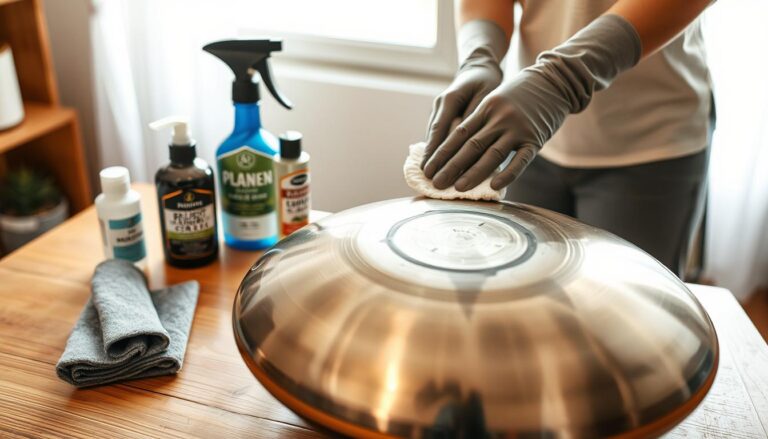
If buying in France, look for a well-tuned instrument (indicative price range: €800 to €2,000). A 9- to 10-note D minor scale is ideal for beginners. Maintain the instrument with a dry cloth and protective oil, then store it somewhere dry.
Vary your practice: play alone to develop precision, then with others to develop your listening. Suggested routine: 10 minutes of technique, 10 minutes of musical expression and 5 minutes of recording. Every note counts: work on the balance between sound, silence and expression.
For simple sheet music and song ideas, see sheet music for an eight-note handpan.