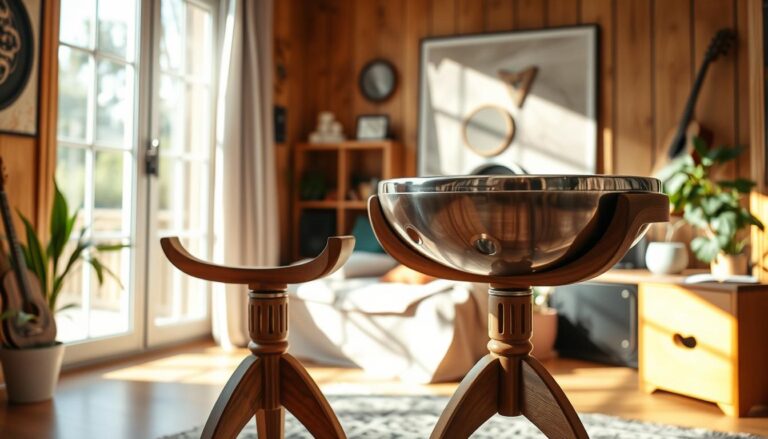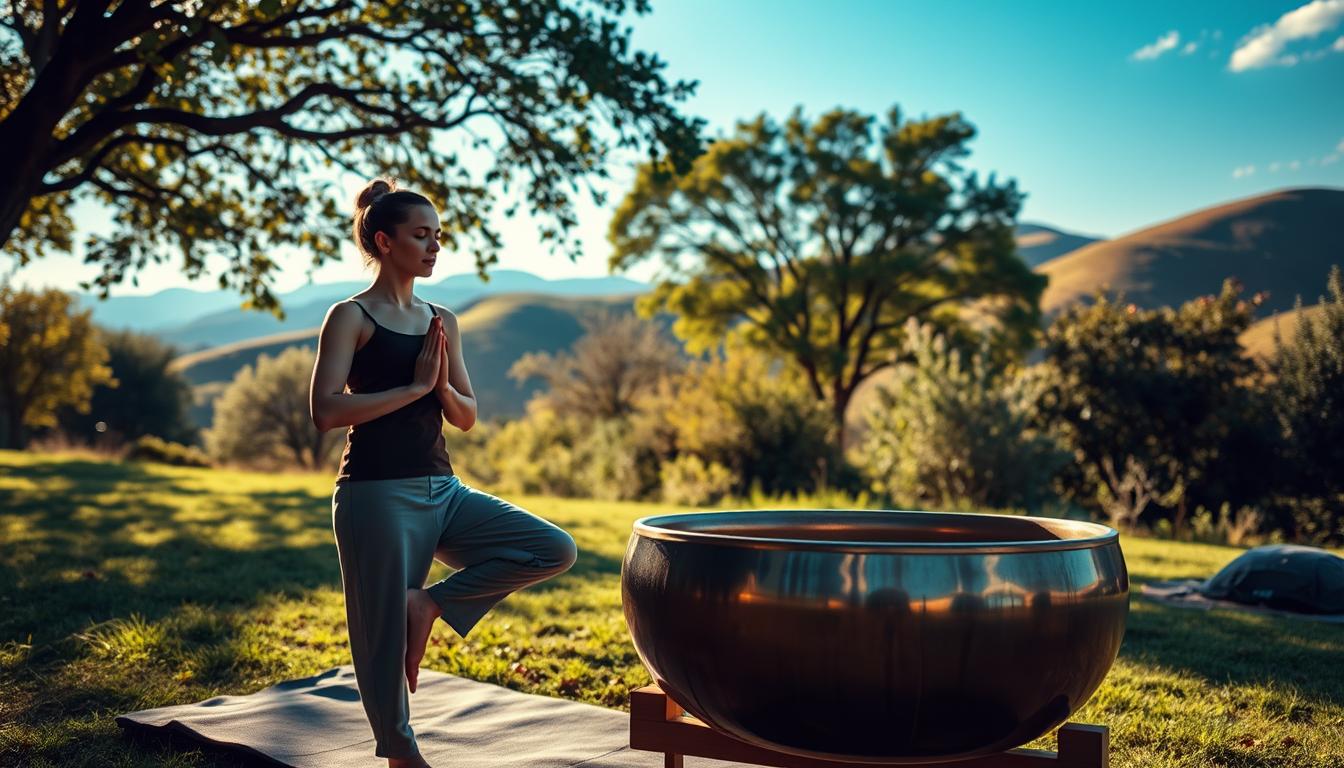
What this guide offers: this guide gives you simple pointers for choosing a tempo, structuring a session, and creating sequences that leave room for the sound to breathe.
Teachers, musicians, and people practicing at home will find clear models here, whatever their level.
By the end, you will know how to build a complete session: warm-up, flow, and cool-down. The principle is simple: silence and breathing matter as much as the music. Tempo becomes a guiding thread for safety and fluidity.
This guide provides BPM ranges for Vinyasa, Hatha, and Yin, along with practical examples. The aim is to create an immersive atmosphere, encourage grounding, and sustain attention, even in a first session.
One small step: try a single tempo for a short sequence, then note how you feel: your breathing, posture, and state of mind. Come back with your feedback and adapt your practice to everyday life.
Why the handpan transforms a yoga session
The resonance of this modern instrument creates a soundscape that supports practice. It guides breathing without words and helps the group stay in sync.
A modern instrument born in Switzerland and designed to resonate
Developed in Switzerland in the early 2000s by Félix Rohner and Sabrina Schärer, this instrument draws on ideas from Asian gongs, the Indian ghatam, and the musical saw. It is designed to produce long, harmonious notes.
During a session, these sustained notes fill the space without overwhelming it. Resonance becomes a reference point for the rhythm of the postures.
Vibration and breathing: a natural connection between body and mind
The vibrations create a sound “bubble” that supports pranayama. Breathing naturally follows the sound cycle without constant verbal instructions.
In practice, sound provides a cue for intensity: a softer sound invites people to slow down, while a fuller sound invites more engagement. This sensory feedback helps the body stay grounded and the mind settle.
- Melodic percussion instrument: long notes for fluid movement.
- Focused resonance: ideal for accompanying breath and alignment.
- Audible cue: keeps the group in sync without constant directions.
The next sections cover measured effects on stress and brain waves, along with practical guidance on BPM, techniques, and sequences. For more on good sound practices, see these recommended practices.
The proven effects of vibrations on body and mind
Musical vibrations affect the nervous system and produce measurable changes. Studies report reductions in salivary cortisol of up to 30–37% after accompanied sessions. This finding supports using sound for relaxation and winding down.
Stress reduction: lower cortisol observed during sessions
Measurements show a clear trend: cortisol falls after prolonged, structured listening. This corresponds to less physiological tension and a more restful state.
Attention and mindfulness: increased alpha waves
Repeated exposure to long notes increases alpha waves. A common effect is a calmer mind and sharper attention. This helps when holding a pose or staying focused during a transition.
Body awareness: grounding, spine, sensations, and posture
Notice these points during a session: the contact of your feet with the floor, the upright position of your spine, and the feeling of your breath as a note resonates.
These cues strengthen your connection with your body and improve alignment. Favor simple, repetitive playing to deepen these effects.
- Better synchronization of breathing.
- Measurable reduction in physiological stress.
- More stable posture and better grounding.
Caution: avoid excessive volume and protect people with severe tinnitus. Use gentle strikes and leave plenty of space in the sound.
| Measure | Observation | Practical implication |
|---|---|---|
| Salivary cortisol | Average decrease of 30–37% after a session | Use for winding down and guided relaxation |
| Alpha waves | Increase associated with calm states | Support mindfulness and concentration |
| Breathing | Better synchronization with sound cycles | Notice grounding and spinal alignment during long notes |
To make these effects more consistent, keep your playing simple, coherent, and uncluttered. Tempo (BPM) is the main tool for turning these benefits into a method. For practical ideas on using sound in meditation, see this article.
Handpan yoga: tempos and sequences that work well
A simple beat is enough to give a session a clear direction. BPM (beats per minute) is the easiest tool for setting the tempo, the breathing timing, and the intensity.
Understanding BPM and the role of notes
Counting a tempo requires no music theory: count 60 beats for a slow minute, then adjust. BPM helps synchronize breathing and transitions.
Each note has a role: the root note grounds the music, while nearby notes create movement. Silences become moments to breathe.
Tempo guidelines by style
- Vinyasa: 90–110 BPM for dynamic transitions.
- Hatha: 75–85 BPM for a moderate, steady rhythm.
- Yin: 60–70 BPM to support stillness and inward listening.
A sound warm-up routine
Begin with 5–7 minutes of a slow, repetitive pattern. The aim is to calm mental restlessness and bring the group together before movement begins.
The dynamic phase and cool-down
During the active phase, maintain a simple, regular groove. Avoid frequent changes that clutter the soundscape.
At the end of the session, favor long notes and flowing melodies. Musical phrases without abrupt breaks encourage relaxation and resonance.
| Phase | Duration | Practical guidance |
|---|---|---|
| Sound warm-up | 5–7 minutes | Slow, repeated pattern, grounded by the root note |
| Dynamic phase | Variable | One rhythmic pattern and one melodic phrase, with a steady groove |
| Cool-down | 3–8 minutes | Long notes, gentle melodies, and built-in silences |
Choosing when to play: warm-up, postures, and relaxation
Choosing when to bring in the instrument can greatly change the quality of a session. At the start, playing sets the mood and helps the group find a shared timing.
During complex postures, gradually reduce the sound. Periods of silence let students adjust their alignment and listen to their sensations.
The transition rule: when to play and when to let silence work
Play mainly during fluid transitions into and out of postures. Allow silence for corrections, long breaths, and small adjustments.
A simple test: do the sequence once with continuous music, then once with breathing room in the sound (short phrases and silences). Compare the group’s stability and adjust the rhythm.
- Play at the beginning to establish the tempo.
- Reduce the sound during technical movements.
- Resume playing at the end to support relaxation.
The difference between filling the space with sound and guiding the group with it lies in your intention, which should serve a practical purpose. Use an anti-vibration stand to steady the instrument, limit unwanted noise, and control the volume more easily.
For safety, simplify your playing immediately if the group starts breathing faster or tensing up. This often signals that the tempo is too fast or the playing too dense.
Essential handpan techniques for yoga
A precise, calm touch supports the practice without overpowering it. Playing with relaxed fingertips produces a clear, warm note. An aggressive strike creates a metallic tone that tires the ear and breaks concentration.
Gentle touch and a breathing exercise
A simple exercise: play one note in time with your breathing. As you inhale, let the note ring. As you exhale, strike gently. Repeat for 3 minutes to learn how to guide without overplaying.
Controlling dynamics
Favor piano for grounding and stretching. Reserve a moderately strong dynamic for active passages. This gives the session structure without distracting students.
Hand independence and melodic lines
One hand lays down a simple pulse while the other plays a short, repeated melodic line. This contrast adds clarity and supports the flow.
Controlled percussion and subtle effects
Add slaps, taps, and muted notes to mark rhythms without creating tension. Use glissando and resonance sparingly during slower moments to enrich the experience.
Progression and routine
Practice slowly with a metronome. Record 2 minutes of playing and listen for the space you leave. Increase the complexity only if the overall feeling remains calm.
| Technique | Purpose | Practical example |
|---|---|---|
| Gentle touch | Clarity without harshness | Play with your fingertips and a relaxed strike |
| Dynamics | Structure the phases | Piano for listening, moderately strong playing for transitions |
| Hand independence | Rhythmic and melodic clarity | Left hand: pulse; right hand: repeated pattern |
| Percussion and effects | Rhythm without tension | An occasional slap or muted note, with glissando at the end of a slow phase |
Building a harmonious sequence: examples of effective flows
Structuring the session helps the practice. Here are four simple models to use in a class or at home.
Vinyasa flow
Keeping a constant tempo (90–110 BPM) for 3–5 cycles steadies the breathing rhythm.
Suggested outline: Sun Salutation A in four beats, a brief hold, and a fluid transition. Keep the same pulse for a reliable rhythm.
Balanced Hatha
Alternate steady holds with opening movements. Use short musical phrases between postures.
Choose a moderate tempo (75–85 BPM) and limit changes to leave room for the teacher’s verbal instructions.
Yin and Yoga Nidra
For Yin, favor long notes and few melodies. A recurring, minimal melody supports holds of 2–5 minutes.
For Yoga Nidra, start with a low, steady root note, then introduce soothing intervals at a low volume.
“Changing just one variable at a time—tempo, density, or register—lets you observe its direct effect on relaxation.”
A practical tip: stick to a small number of compatible scales (pentatonic if possible) to avoid harmonic tension. If the session grows more intense, simplify the music; if it slows down, let notes resonate longer instead of adding more.
Creating a consistent sensory setting for a group or at home
Setting up the space turns an ordinary room into a sound bubble suited to practice.
Space, acoustics, and intention: turning a room into a “bubble”
A small, reverberant room amplifies resonance. Sound carries far, but it may make the guide’s voice harder to hear.
A heavily damped studio calls for clearer, less busy playing. Otherwise, you may be tempted to raise the volume.
Before playing, set an intention: grounding, energy, or release. This guides your choice of notes, density, and rhythm.
Useful accessories: an anti-vibration stand and volume control
Guidelines for the group: place the instrument in the center or slightly off-center for even sound distribution. Do not put it too close to participants.
A simple test: speak at your normal volume. If you have to strain to be heard, turn the music down.
- Anti-vibration stand: reduces unwanted body noise and steadies the sound.
- Floor mat or insulation: softens unwanted low-frequency resonance.
- Soft protection: prevents mechanical clicks when striking.
With its sustained notes, this instrument can replace or complement a kalimba or chimes. Those instruments have shorter attacks; here, sustained notes guide the breath.
| Element | Effect | Recommended action |
|---|---|---|
| Reverberant room | Amplifies resonance | Reduce reflective surfaces or lower the volume |
| Damped studio | Clear sound with limited projection | Use simple patterns and avoid overcrowding the sound |
| Placement | Even sound distribution | Instrument in the center, audience in a semicircle |
| Listening test | Checks for listening fatigue | Record 30 seconds in several places and adjust |
To deepen your experience in a group, consider attending local workshops. They can help you adapt the stand and instrument to your setting.
Choosing your instrument and progressing faster
Before buying, identify the qualities that make playing easier. Tuning quality, stable notes, and even resonance are essential.
Quality, tuning, and price: what to check
Ask for a tuning certificate and an anti-corrosion treatment. These help ensure durability and prevent tuning problems that tire the ear.
A price guide: expect to pay between €900 and €2,000 for a reliable instrument. A low-priced instrument may look appealing, but it can make working on tempo and rhythm harder.
A practice routine for progress
Work with a metronome and start slowly. Pair your breathing with a slow tempo, then add small variations.
Weekly sequence: 5 minutes of steady pulse, 10 minutes linking two patterns, then 5 minutes of short improvisations (2 minutes each), keeping a grounding → development → return structure.
Learning in workshops and playing in a group
Taking part in workshops speeds up progress. Group practice strengthens listening skills and helps you correct habits.
“Playing with other musicians turns a routine into real progress.”
To start learning to play, look for local sessions: workshops in France have increased by about 40% since 2020.
Conclusion
Finish with a simple rule: choose a tempo suited to the style, limit the number of notes and patterns, and structure the session as warm-up → active phase → cool-down while leaving room for silence.
Resonance and vibrations support breathing and attention. Music should guide without distracting, especially when the practice becomes technical. Work on a gentle touch, steady pulse, and short transitions.
Quick checklist: low volume, delicate touch, clear pulse, brief transitions, and a test in the actual space. To improve, learn one technique at a time (dynamics, hand independence, muted notes), then use only what is needed.
Try a short 15-minute routine: ground the music on a root note, play a simple groove, add a three-note melody, and wind down. Connect with the community and read resources on the instrument’s origins and use or on instrument making and passing on skills to enrich your experience.